Georges Rochegrosse
1859–1938 · France · Symbolism, Orientalism
The story
In the Paris Salons of the 1880s, Georges Rochegrosse made his name on horror. His breakthrough canvases were enormous and violent, crowds trampling a dying emperor, the sack of a doomed city, painted at a scale meant to fill a wall and unsettle the room in front of it. His 1883 Andromaque, showing the widow of Troy torn from her child, won that year's Prix du Salon and marked him at 24 as a coming man of French history painting.
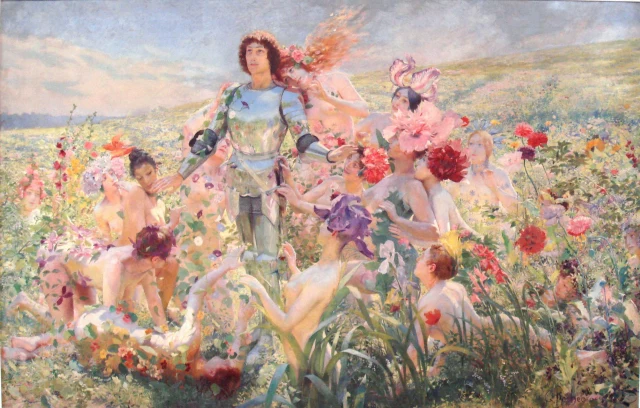
The work most people meet now is far calmer. Le Chevalier aux fleurs, finished in 1894 and hanging in the Musée d'Orsay in Paris, takes its subject from Wagner's opera Parsifal: a young knight walks unmoved through a meadow of flower-maidens sent to seduce him, the canvas nearly four metres wide and drowned in blossom. The taste for the exotic that runs through his work pulled him steadily toward North Africa.
Rochegrosse spent his later decades in Algeria and died in Algiers in 1938, painting its light and its gardens far from the Salon crowds that had once queued for his battles.