Gerolamo Induno
1825–1890 · Kingdom of Lombardy–Venetia, Kingdom of Italy · Romanticism
The story
In the summer of 1849 a young Milanese painter was badly wounded by bayonets at the Villa del Vascello, on the western edge of Rome, where volunteers were holding back French troops sent to put down the short-lived Roman Republic. Gerolamo Induno had fought the year before in the Five Days of Milan, the rising against Austrian rule, and had slipped across the border into Ticino when it collapsed.
He recovered and kept both lives going. In 1855 he went to the Crimea with the Bersaglieri, the light infantry of Piedmont, and turned his sketches of the camps and the fighting into paintings. One of them, the battle of the Chernaya, was bought by Victor Emmanuel II, then king of Piedmont-Sardinia. Garibaldi, whose campaigns he followed, called him the painter of the Risorgimento. In 1861 a jury awarded him a gold medal for a canvas of the battle of Magenta and he refused it, in protest at the painters it had passed over.
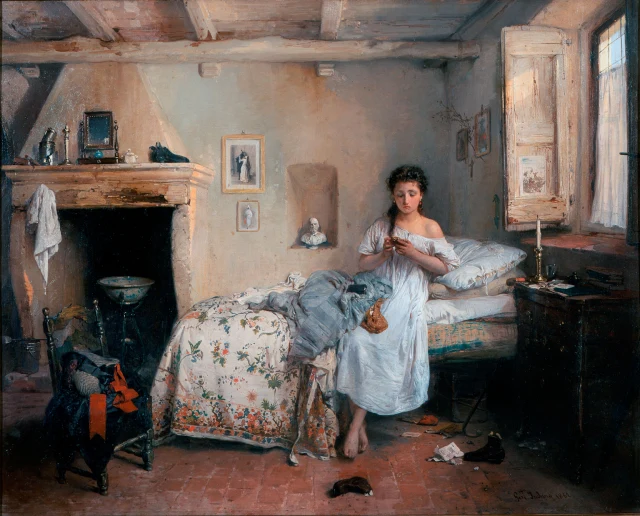
What he is best known for now is quieter. Triste presentimento, painted in 1862, puts a young woman on the edge of an unmade bed in a small room, looking at a photograph. A plaster bust of Garibaldi stands in a niche behind her, and a print of red-shirted volunteers is pinned to the window shutter. His elder brother Domenico Induno was painting the same kind of domestic interior in Milan, and the two often worked side by side. In 1871 Gerolamo painted the scene a second time, with the young woman's face changed and the bust of Garibaldi left out.