Giovanni del Biondo
1398 · Republic of Florence · Gothic
The story
In October 1356 the government of Florence granted citizenship to a painter from Pratovecchio, a village in the Casentino, the wooded upper valley of the Arno. He was already a trained master, so he was probably born in the early 1330s. That grant is the first trace of Giovanni del Biondo, and from then on the city's tax rolls list him regularly for the next four decades.
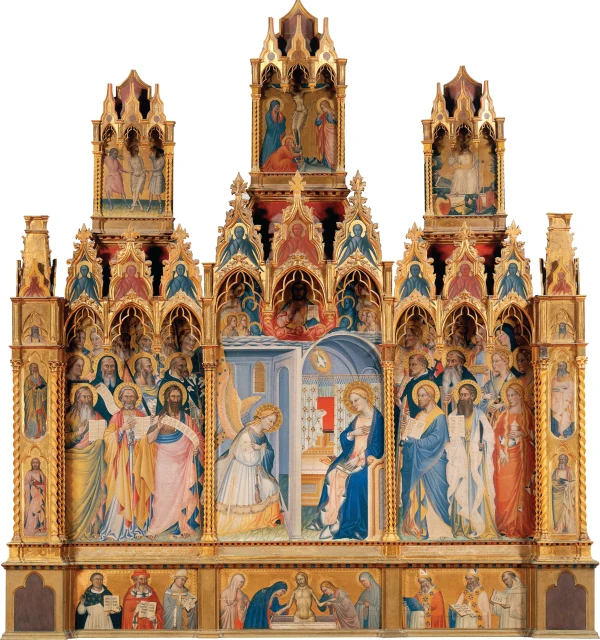
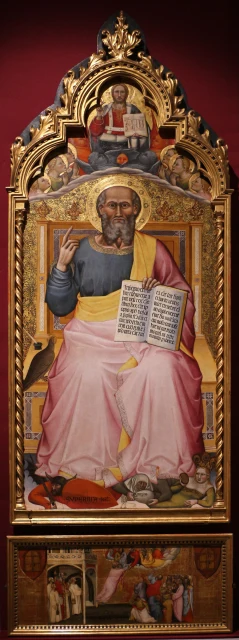
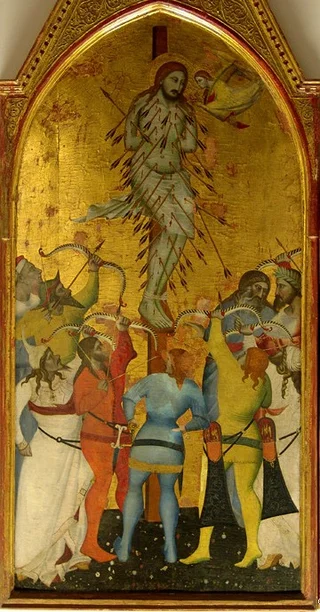
He came up inside the busiest workshop in Florence, run by the brothers Andrea di Cione, called Orcagna, and Nardo di Cione, and he stayed close to that family all his life, later working beside the youngest brother, Jacopo. What he learned there he hardened into a manner of his own: upright, rather stiff saints, bright unshaded colour and sharp, almost spiky faces. Only two of his surviving altarpieces carry his signature, yet the style is so recognisable that scholars have gathered a large body of unsigned panels around his name.
One of the finest is still in Santa Croce, the great Franciscan church of Florence, on the altar of the Rinuccini chapel, dated 1379. He died in Florence on 19 October 1398, and the Company of the Purification and Saint Zanobi, a lay confraternity that counted many artists among its members, helped pay for his funeral.