Giovanni di Paolo
1403–1482 · Republic of Siena · Sienese school
The story
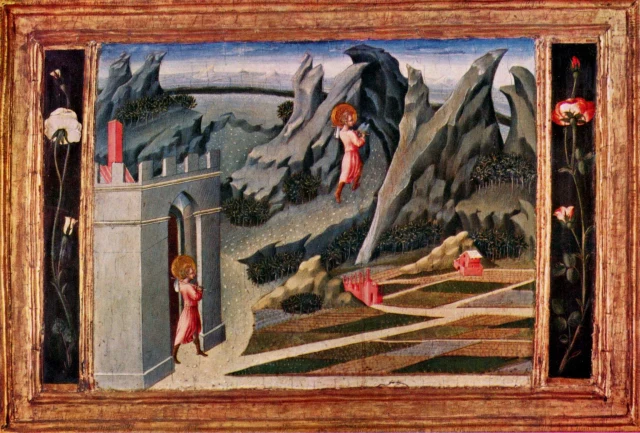
By the time Giovanni di Paolo was at work in Siena, Florence a day's ride away had already turned to perspective, anatomy, and the measured space of the early Renaissance. Siena went its own way, and so did he. He kept the gold grounds and the tilting, dreamlike space of an older art and pushed them toward something stranger.
One of his small panels, now in New York, sets out the whole cosmos as a diagram: the earth ringed by the four elements, the planets, and the band of the zodiac, with God swept in on the shoulders of angels. Beside it, Adam and Eve are hurried out of a flowering garden. It reads less like a scene you could stand in than a vision you have been shown.
That gift for picturing the invisible won him one of the great commissions of the age. Around 1444, for Alfonso of Aragon, king of Naples, he illuminated Dante's Paradiso, the hardest part of the poem to draw, because so little of it happens on the ground. He made 61 small paintings for it, giving shape to light, music, and the ranks of the blessed. The manuscript is now in the British Library in London.