Giusto de' Menabuoi
1330–1390 · Republic of Florence · Early Renaissance
The story
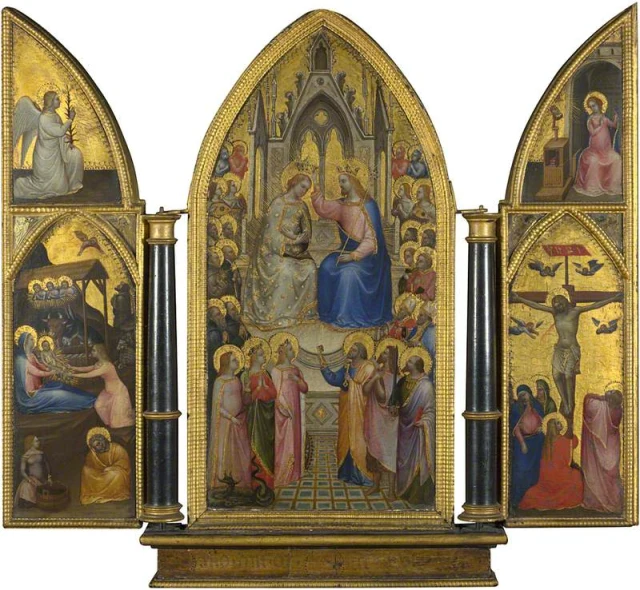
Giusto de' Menabuoi trained in Florence, in the long shadow of Giotto's revolution in painting, but his masterpiece stands far to the north, in Padua. Around 1370 he settled in that city, then ruled by the Carrara family, and became their court painter.
His great commission came from Fina Buzzaccarini, wife of Francesco il Vecchio, the lord of Padua. She wanted the cathedral's baptistery — a small domed building beside the main church — turned into a private mausoleum for herself and her family, and between roughly 1375 and 1378 Giusto covered every surface of it in fresco. The cycle runs through the whole of salvation history, from the Creation in Genesis to the visions of the Apocalypse.
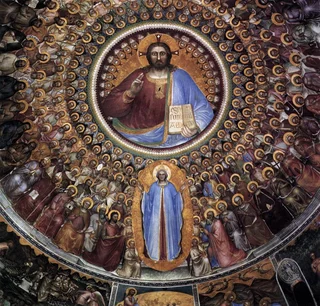
Look up into the dome and you meet its most astonishing passage: a vast Christ ringed by circle upon circle of saints and angels, hundreds of small faces arranged like a diagram of heaven. Fina died in 1378, just as the work was finishing, and was buried in the room she had ordered. Her tomb was later removed, but the painted paradise she commissioned is still overhead.