Gorgon Painter
Ancient Greece · Archaic Greek art
The story
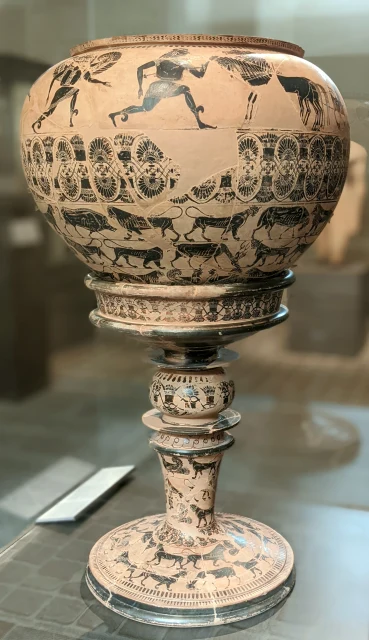
Nobody knows what this man was called. In the decades after 600 BC he painted pots in Athens, and like most craftsmen in his trade he did not sign them. The name we use comes from one vessel, a huge bowl for mixing wine on its own tall stand, now in the Louvre. In its top frieze the hero Perseus runs from two Gorgons, the snake-haired sisters of Medusa, whose head he has just cut off. Modern scholars took the monsters on that bowl as a label for the hand that painted it, and every vase they recognise as his is credited to the Gorgon Painter.
That story scene is rare in his work. Most of what he painted is rows of animals, lions, panthers, goats and sphinxes, walking in bands around the pot, a fashion Athens borrowed from Corinth, its rival in the pottery trade. He worked in black-figure, dark silhouettes with the details scratched through to the clay and touches of red laid on top. He is thought to have followed an older Athenian master known as the Nessos Painter. Sophilos, who worked in Athens a little later, is the first vase painter there whose own name survives, written on his pots.