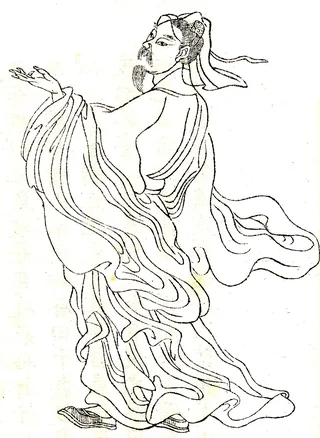
Gu Kaizhi
345–406 · Eastern Jin dynasty · Chinese painting, Eastern Jin dynasty art
The story
In the 4th century, a monastery in the Eastern Jin capital of Jiankang, today's Nanjing, was raising money for a new hall. A young painter named Gu Kaizhi pledged a million in cash, an absurd sum for a man with none. He asked only for a blank wall. Over several days he painted the Buddhist sage Vimalakirti on it and left the eyes undone, then announced that the first visitors to watch him add the pupils would pay to get in. Crowds came, the pledge was met, and the tale followed him for the rest of his life.
Gu served at the Jin court and wrote some of the earliest Chinese essays on painting, arguing that the whole life of a figure sits in the eyes, which is why he dotted them last and with care. His contemporaries summed him up in three words, calling him supreme in talent, supreme in painting, and supreme in folly, that last for the childlike credulity he was known for.
Almost nothing survives from his own hand. What we have are later copies, above all the Admonitions of the Court Instructress, a silk handscroll of palace women being lectured on virtue, kept now in the British Museum in London. Scholars date the surviving version to a few centuries after his death, copied by an unknown hand, yet its thin, floating line is what generations of Chinese painters studied as the model for drawing a human figure.
