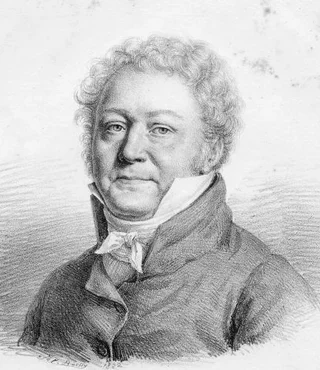
Guillaume Guillon-Lethière
1760–1832 · France · Neoclassicism
The story
Guillaume Guillon-Lethière was born in 1760 in Sainte-Anne, on the Caribbean island of Guadeloupe, the son of a white French official and a freed woman of African descent. That he rose from there to the summit of French painting is the improbable fact at the centre of his life.
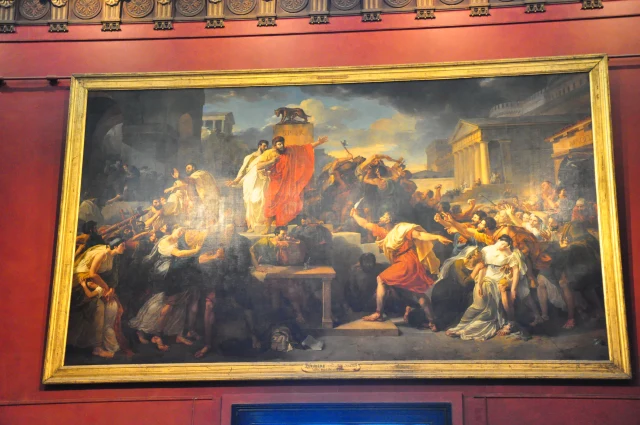
Sent to France as a boy to train, he became a leading history painter of the Neoclassical generation, the style of grand ancient subjects and clear, sculptural drawing. He was a direct rival of Jacques-Louis David, the era's dominant painter, ran a busy teaching studio, and in 1807 was made director of the French Academy in Rome, one of the most prestigious posts an artist could hold. His huge canvases of Roman virtue, among them the sons of Brutus condemned to death by their own father, hung in the Salon beside the greatest names of the day.
His most personal picture came in 1822. Called The Oath of the Ancestors, it shows two founders of independent Haiti, the general Dessalines and the mixed-race leader Pétion, swearing alliance under a broken chain, the first Black republic given a Neoclassical altarpiece of its own. Lethière sent it quietly to the island, where it still hangs in Port-au-Prince. For most of the two centuries after his death in 1832 his name faded, until the Louvre gave him a full retrospective in 2024, taking for its title the phrase he had used of his own origins, born in Guadeloupe.