Guo Xi
1020–1090 · Song dynasty · Chinese landscape painting, Northern Song painting
The story
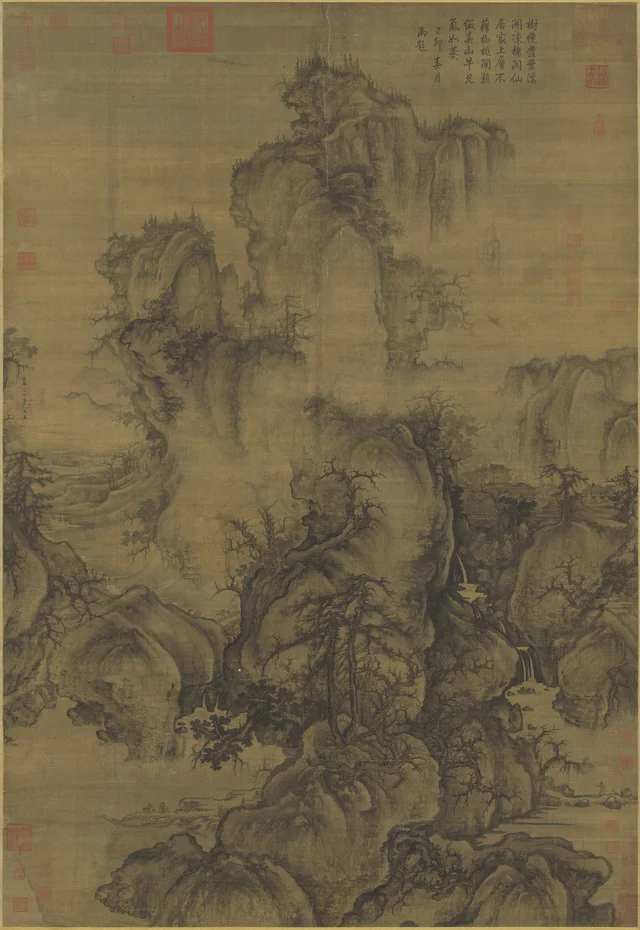
Around 1072, a court painter named Guo Xi finished a tall silk scroll he called Early Spring, and set down in writing exactly what he thought a mountain was for. A good landscape, he argued, is one a person could walk into, wander through, and want to live in. You should be able to feel the season and hear the water.
Early Spring puts that idea to work. The mist has not lifted, the ground is thawing, and the whole mountain seems to twist and breathe as your eye climbs it. Guo Xi built the view from several vantage points at once, so a single painting holds the near valley, the middle path, and the far peaks together, a method he called the angle of totality. His pines curl like crab claws and his rocks pile in soft, cloudlike shapes, brushwork that painters copied for centuries after.
He worked for Emperor Shenzong, whose new palace walls he covered with landscapes, and he was well enough read to write his thinking down. That treatise, The Lofty Message of Forests and Streams, was gathered and edited by his son Guo Si, who added his father's remarks on how the same hills look different in morning and evening, and in each of the four seasons.