Gustave De Smet
1877–1943 · Belgian · Flemish Expressionism
The story
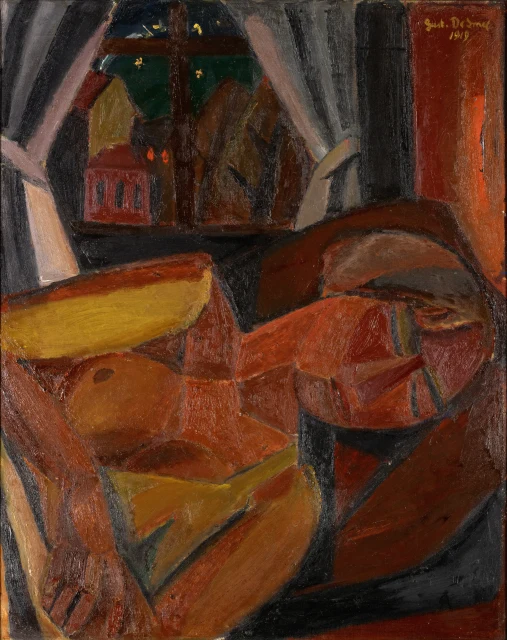
In 1914 the German army moved into Belgium, and Gustave De Smet packed up and crossed into the neutral Netherlands. He would stay there eight years, and those years remade him as a painter. Before the war he had worked in soft, sunlit dabs, close to the luminist manner of the Lys valley south of Ghent, where he had joined the artists' colony at Sint-Martens-Latem. In Dutch exile he met the harder edges of German Expressionism and the new Cubist geometry, and his world went flat, dark and blocky.
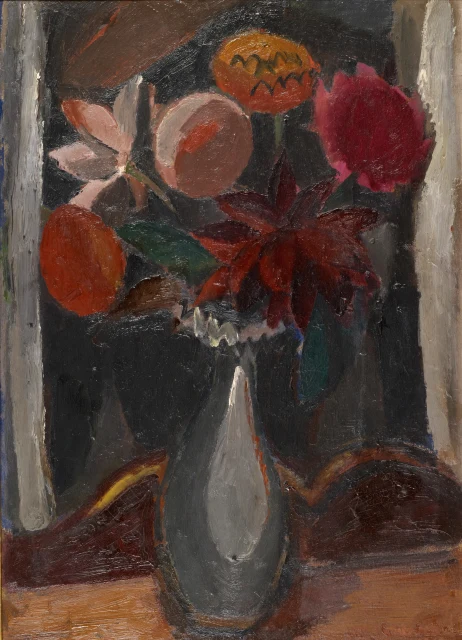
The two canvases here in Basel both date from 1919, near the end of that stay. A sleeping woman, a bunch of dark flowers, ordinary subjects rebuilt out of heavy planes and muted colour, the figures simplified almost to wooden dolls. Back home in Belgium he became, with his friends Constant Permeke and Frits Van den Berghe, one of the founders of Flemish Expressionism, the movement that carried this weightier, earthbound look through the 1920s.
His older brother Léon De Smet kept to brighter, gentler painting, and the two are still sometimes confused. Gustave died in Deurle, on the same river Lys where he had started out, in 1943.