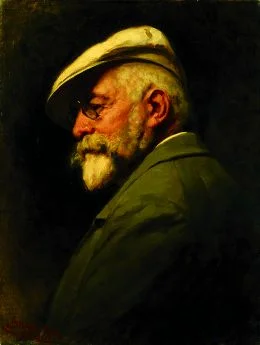
Gyula Benczúr
1844–1920 · Hungary · Academic art
The story
Gyula Benczur made his name far from home. Trained in Munich, he caught the eye of Ludwig II of Bavaria, the young king remembered for his fairy-tale castles, who handed him one commission after another and in 1875 had him made a professor at the Munich Academy. For a Hungarian from Nyiregyhaza in the country's east, that was a rare height in the German art world.
In 1883 he went back to Hungary to teach, and there he became the country's great painter of historical set pieces. His best-known canvas, finished in 1896 for Hungary's millennial celebrations, is the Recapture of Buda Castle, which marks the 1686 expulsion of the Ottomans from the city. It stages the victory parade with Charles of Lorraine, the campaign's commander, seated high on a white horse at the centre.
Benczur worked in the polished academic manner, all careful drawing and rich costume, at the very moment younger painters were turning against it. He kept at portraits and grand history to the end, and remained the reigning teacher of the style in Budapest until his death in 1920.