Han Gan
706–783 · Tang dynasty · Tang dynasty painting, Chinese brush painting
The story
Han Gan grew up poor, working as a hired hand delivering wine in Chang'an, the Tang capital. Early Chinese accounts say he was sent to collect a debt at the home of the poet and painter Wang Wei, drew figures in the dirt while he waited, and came away with a patron who paid for his training for the next ten years. By the 740s he was painting at the court of Emperor Xuanzong, who took horses seriously. Central Asian imports filled the palace stables, and about 100 of them were trained to dance to music at the emperor's birthday festival. When Xuanzong told him to study under Chen Hong, the court's established horse painter, Han Gan answered that he already had teachers, the horses in the imperial stables.
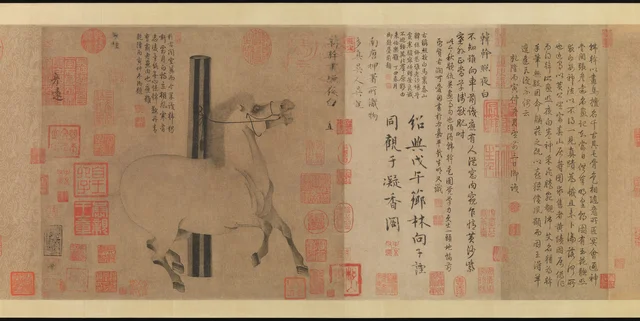
Night-Shining White was one of Xuanzong's own chargers, named for its pale coat. Han Gan drew it tethered to a post and fighting the rope, eye rolling, nostrils open, forelegs off the ground. It is ink on paper, with no colour anywhere. The poet Du Fu, writing in those same years, complained that Han Gan painted flesh without bone, all well-fed court horse and too little hard structure underneath. Those were the horses standing in front of him at court. In 755 the An Lushan rebellion drove Xuanzong out of the capital, and the stables that bred them went with him.
The horse itself is small, about 30 by 34 centimetres. The scroll it is now mounted on runs 11.4 metres, and nearly all of that length is other people. A title inscription is credited to Li Yu, the last ruler of the Southern Tang, there are notes by later collectors including the Song connoisseur Mi Fu, and the seals run on down to the Qianlong emperor in the 18th century.