Hans Siebenbürger
1440–1483 · Holy Roman Empire · Late Gothic
The story
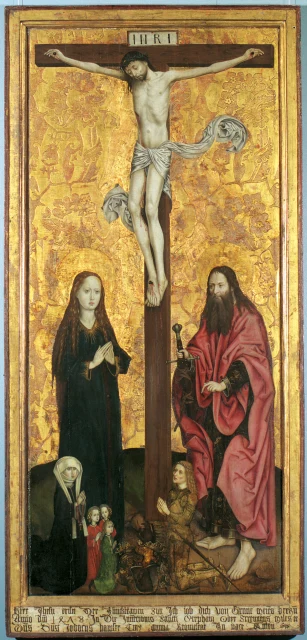
In 1479 a Vienna painter named Hans Siebenbürger was paid for a memorial panel, and the record of that payment is what lets historians attach his name to a painting. The panel is a Crucifixion made for the tomb of Jodok Hauser, a knight who died in 1478. At the foot of the cross the knight kneels with his wife and their three children, and an inscription on the original frame names him as the donor. The painting later hung in the Minorite Church in Vienna and came to the Belvedere in 1953. It is the only work that written sources tie securely to Siebenbürger.
His surname means the Transylvanian, and he was probably born there around 1440. In Vienna he married a widow, Ursula, who brought two houses into the marriage, and by 1483 both of them were dead. Because the Hauser panel is securely his, historians use it as a yardstick. The art historian Robert Suckale proposed that Siebenbürger was the anonymous painter of the Schotten Altarpiece, made for the Schottenstift, a Benedictine abbey in Vienna. Its panels include some of the earliest views of the city. Not every scholar accepts the identification. Comparing faces with the Hauser panel, researchers have also linked him to two scenes from the life of Saint Barbara now in England, at York Art Gallery and at Upton House.