Henry Wallis
1830–1916 · United Kingdom of Great Britain and Ireland · Pre-Raphaelitism
The story
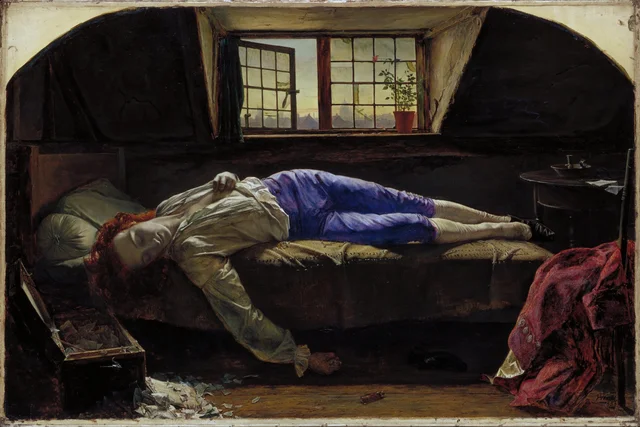
The poet Thomas Chatterton was 17 when he was found dead in his London garret in 1770, poisoned with arsenic. In 1856 Henry Wallis, then 26, showed The Death of Chatterton at the Royal Academy, and the picture now hangs in Tate Britain. The boy lies sprawled across the bed with torn papers on the floor, and the critic John Ruskin called the painting faultless and wonderful.
The model for the dead poet was the writer George Meredith, then 27, a decade older than the boy he stood in for. Meredith's wife Mary Ellen, a daughter of the novelist Thomas Love Peacock, soon began an affair with Wallis, left her husband and in 1858 had a son by the painter. Meredith later turned the collapse of his marriage into Modern Love, a sequence of poems.
Wallis went on for a time in the same exacting Pre-Raphaelite manner, the style of sharp detail and bright colour that Ruskin championed, most memorably in The Stonebreaker, a labourer lying dead by the roadside. Over the following decades he turned increasingly to collecting and writing, and he became a respected authority on Persian pottery and Italian maiolica.