Hippolyte Flandrin
1809–1864 · France · Neoclassicism
The story
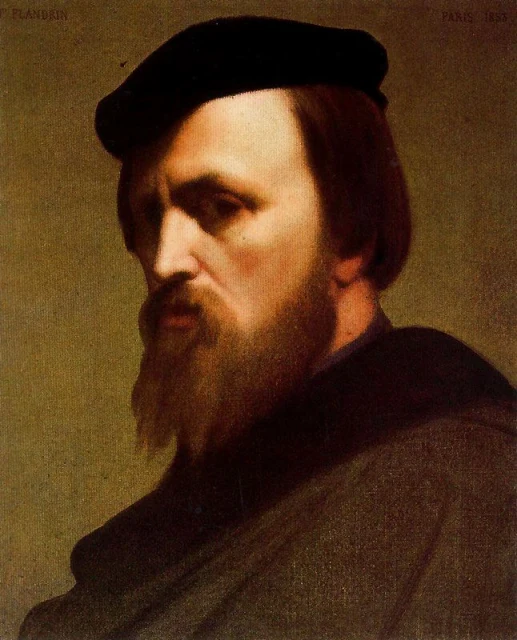
Hippolyte Flandrin arrived in Paris in 1829 from Lyon, poor enough that the journey itself was a gamble, and walked into the studio of Jean-Auguste-Dominique Ingres, the reigning master of French classical drawing. Ingres came to treat the young man almost as a son. In 1832 Flandrin won the Prix de Rome, the state prize that paid for years of study in Italy.
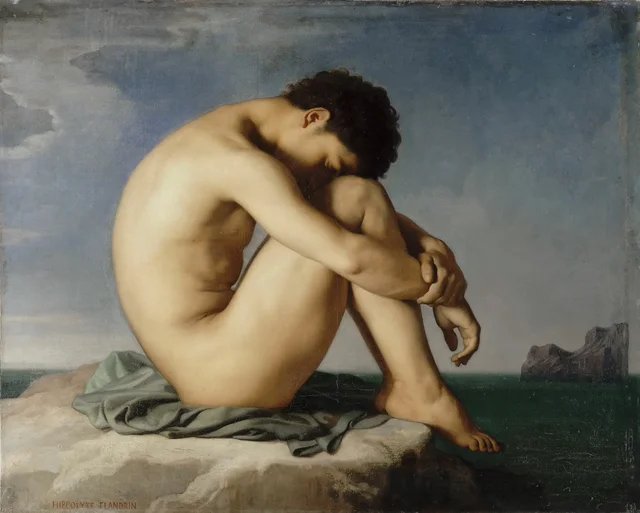
It was there, looking at the sea, that he painted the work most people know him by today: a young man sitting nude on a rock by the water, knees drawn up, curled into himself, quiet and self-contained. It hangs in the Louvre.
The rest of his life went onto church walls. Through the 1850s he covered the interiors of Saint-Vincent-de-Paul and Saint-Germain-des-Prés in Paris with long processional friezes of saints, work that made him the leading religious muralist of his day in France. He kept at those vast surfaces almost to the end, dying in Rome in 1864, two days before his 55th birthday.