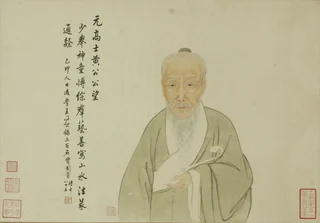
Huang Gongwang
1269–1354 · Yuan dynasty · Yuan dynasty painting, Literati painting, Landscape painting
The story
Huang Gongwang was past 50 before he seriously picked up a brush. He had spent his working life as a clerk under the Mongol Yuan dynasty, until his superior was charged with corruption and Huang went to prison alongside him. He came out a middle-aged man with no career, joined the Quanzhen sect of Daoism, and made his living telling fortunes in the towns around Hangzhou.
The painting that made his name came near the end of that long second life. Around 1347, in his late 70s, he began a handscroll of the Fuchun Mountains, the river country south of the Yangtze where he had retired. He worked on it on and off for about three years, unrolling it to add a stretch of misty hills or a few rustic dwellings whenever the feeling took him. The finished scroll ran some 7 metres, and it became a model that every later Chinese landscape painter measured himself against. Huang is counted as the oldest of the Four Masters of the Yuan, the painters who set the standard for scholarly landscape.
The scroll nearly did not survive. In 1650 a collector named Wu Hongyu, who loved it so much he kept it beside him while he ate and slept, asked on his deathbed for it to be burned so it could follow him into the afterlife. His nephew snatched it from the flames, but not before the fire had split it in two. The larger section is now in the National Palace Museum in Taipei, the smaller fragment in the Zhejiang Provincial Museum in Hangzhou. In 2011 the two halves were shown side by side in Taipei for the first time in more than 300 years.
