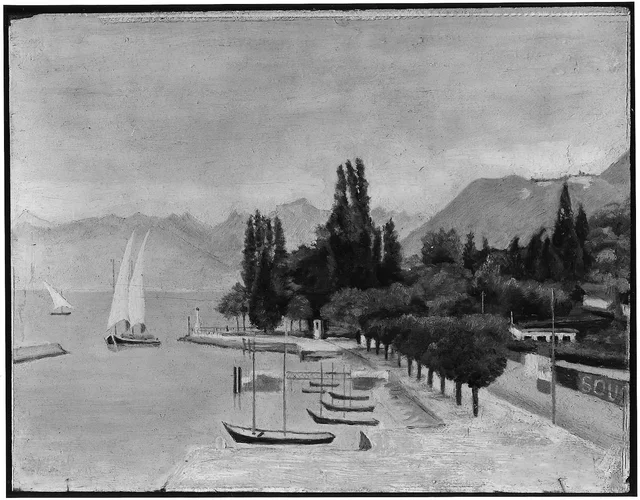
Imitator of Henri Rousseau
The story
Imitator of is the furthest a museum's label can stand from a famous name. It covers a picture made by someone outside the painter's circle, often after his death, in a manner meant to look like his work, whether as homage or to be sold as the real thing.
Henri Rousseau, the self-taught Paris painter of jungles and city outskirts who died in 1910, invited imitation more than most. His flat, careful, untrained-looking style seemed easy to reproduce, and his reputation climbed quickly once he was gone. In 1911 the Salon des Indépendants, the open exhibition where he had shown for years, held a retrospective of his work, and between the wars his canvases entered collections as serious as those of Albert Barnes in Philadelphia and Samuel Courtauld in London.
The experts have never fully agreed on where his own work ends. Henry Certigny's catalogue of Rousseau's paintings, published in 1984, listed 323 works and was followed by four supplements, and his papers record a long dispute with the other leading Rousseau specialist, Dora Vallier, over which pictures were genuine. They also keep a list of the paintings he refused to accept.