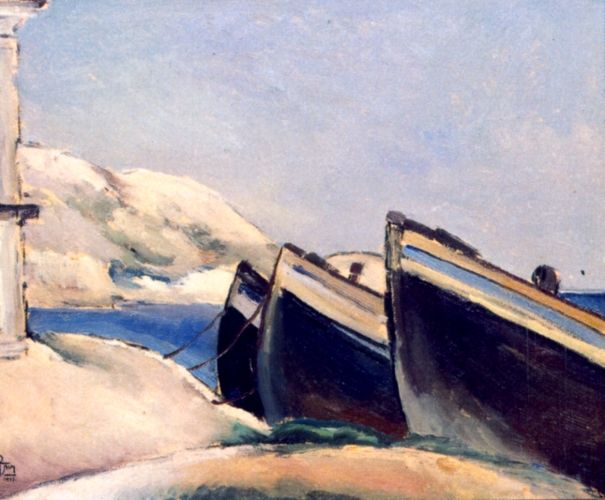
Ion Theodorescu-Sion
1882–1939 · Romania · Post-Impressionism, Symbolism
The story
Romania entered the First World War in 1916 and lost two thirds of its territory within months. Ion Theodorescu-Sion was sent to the front by the General Headquarters as an official war artist, and ended up fighting there. He came back with his standing raised and his painting pointed somewhere new.
Before the war he had been hard to pin down. Born in 1882 at Ianca, in the plains of eastern Wallachia, academically trained and then a student in Paris, he worked through post-Impressionism, Divisionism, Symbolism, touches of Fauvism and even of Cubism, one manner after another. From the mid-1920s he settled into a deliberately traditionalist idiom instead, tied to the circle around the literary magazine Gandirea, which argued that Romanian art should grow out of Orthodox church painting and village life. He flattened his figures, borrowed the gold and the frontal poses of Byzantine icons, and painted peasants at work.
He also went to Balcic, the small Black Sea port that Romania then held in southern Dobruja, and painted its light, its shore and its boats. In Bucharest he kept a place at Capsa, the cafe where writers and painters had their table, and taught at the Academy of Fine Arts until his death in 1939.