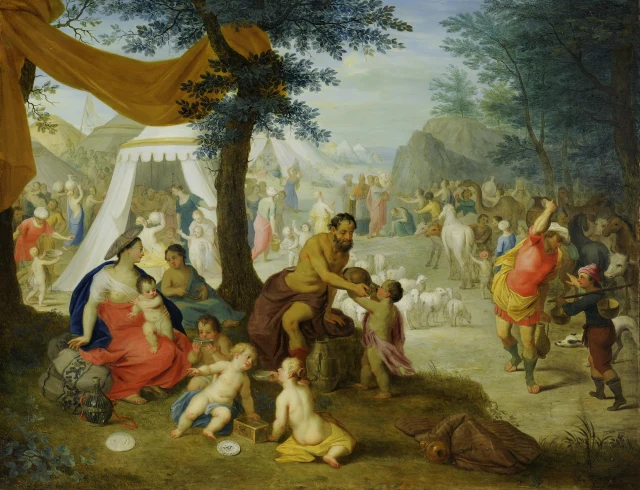
Jacob Andries Beschey
1710–1786 · Austrian Netherlands · Flemish Baroque
The story
Antwerp in the 1720s was still earning a living from a painter who had been dead for more than 80 years. Peter Paul Rubens died in 1640, and his compositions went on circulating as engravings that any workshop could buy and follow. Jacob Andries Beschey, sworn in as a master of the city's Guild of Saint Luke in 1726 at the age of 16, worked inside that trade: small religious pictures, Flagellations and suppers at Emmaus, built on Rubens and his followers and usually taken at one remove, from a print.
He was one of five brothers who all painted. Balthasar taught and helped build up the Antwerp academy, Carel did landscapes, Jan Frans sold pictures in London, and Jacob Andries dealt a little himself alongside the brush. He took pupils between 1732 and 1754 and served as dean of the guild in 1766, which in Antwerp meant running the painters' affairs for a year. The Hermitage in Saint Petersburg, the Alte Pinakothek in Munich and the Prado in Madrid each hold a religious panel by him, none of them large.