Jacob Coeman
1632–1676 · Dutch Republic · Dutch Golden Age, Baroque
The story
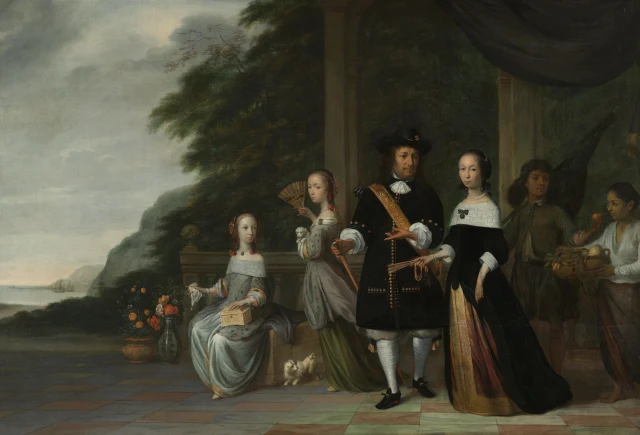
In Batavia in 1665, the Dutch East India Company's capital on Java, Jacob Coeman painted a merchant family on the terrace of their house. The man is Pieter Cnoll, the Company's first senior merchant in the city. His wife, Cornelia van Nijenrode, was the daughter of a Company merchant in Japan and a Japanese woman, and their daughters Catharina and Hester stand beside them with a fan, a small dog and an ivory box.
Behind the family stand two people the household owned. An enslaved woman carries a basket of fruit, and her name was not recorded. The young man is most probably Surapati, who later escaped slavery, fought first for the Company and then against it, and became a ruler in East Java. Indonesia honours him today as a national hero. The Rijksmuseum, which holds the painting, has retitled it so that the two enslaved servants are named in it.
Coeman came from Amsterdam, where his father lived on the Kalverstraat, and he painted portraits there in the manner of Thomas de Keyser, the city's leading portraitist of the previous generation. In 1663 he sailed for Batavia, about two years before this commission. There he painted the colony's officials, among them Joan Maetsuycker, the governor-general of the Dutch East Indies, and he died in Batavia on 9 April 1676.