Jacopo de' Barbari
Republic of Venice · Renaissance, Northern Renaissance, Italian Renaissance
The story
Around 1500 Jacopo de' Barbari did something almost no Italian artist of standing had tried: he left Venice for good and took service at courts in Germany and the Low Countries, carrying Renaissance drawing north with him. In his own lifetime that made him a rare bridge between two art worlds.
Before he went, he had designed one of the wonders of early printmaking, a bird's-eye map of Venice cut from six great woodblocks and more than two and a half metres wide, showing every canal, ship and rooftop as if seen from high above the lagoon. Soon after, he entered the service of the Holy Roman Emperor Maximilian I and moved between Nuremberg, Wittenberg and other German towns. There he knew Albrecht Dürer, the leading German printmaker, and the two shared a fascination with the mathematics of ideal human proportion.
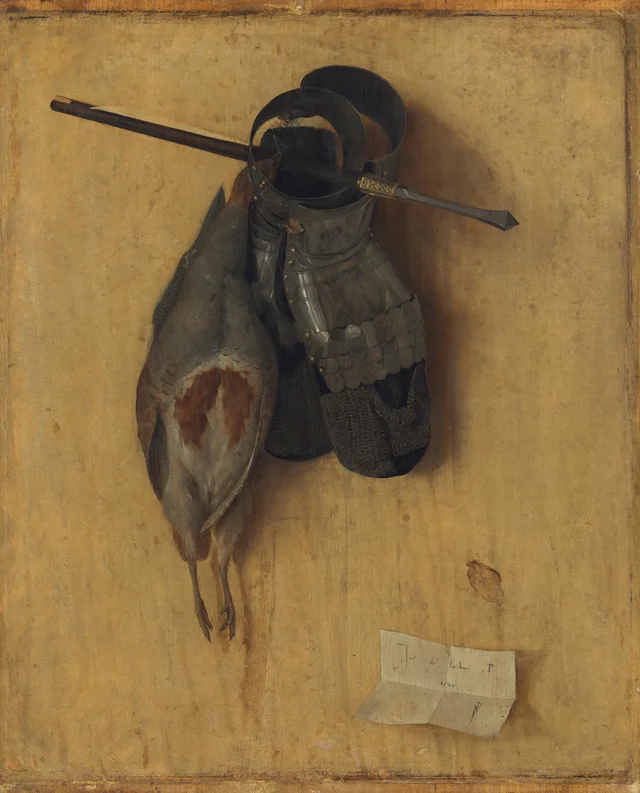
His smallest surviving picture may be the most quietly important. In 1504 he painted a dead partridge hung on a wall beside a pair of iron gauntlets and a crossbow bolt, signed and dated, marked with the little caduceus he used instead of a name. It is often called the earliest independent still life in European painting. He was still drawing a court salary in the Netherlands when he died, some time before 1516.