Jacques Linard
1597–1645 · France · Baroque, Still life painting
The story
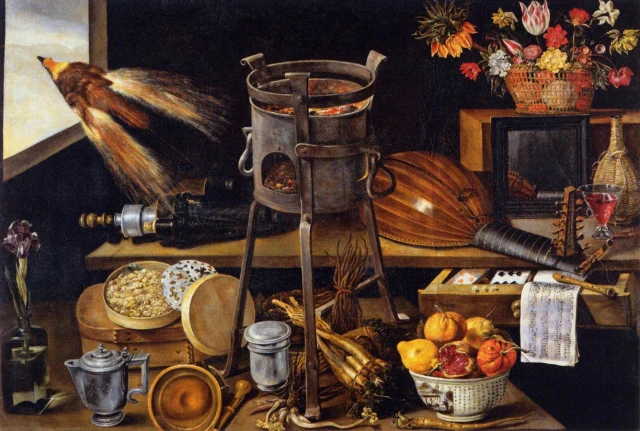
In 1627, the year Cardinal Richelieu, the king's chief minister, laid siege to the Protestant port of La Rochelle, a painter from Troyes signed a large still life on the front of a table drawer. Jacques Linard filled it with a lute, a mirror, flowers, fruit, a small brazier and a pitcher, each standing for one of the five senses or the four elements. On one vessel he painted three chevrons, the arms of Richelieu's family, perhaps in the hope of catching the cardinal's eye. The canvas belongs to the fine-arts museum in Algiers and has hung in the Louvre since 1970.
Linard was the son of an artist in Troyes, in Champagne, and was working in Paris by 1626. Five years later the records call him painter and valet de chambre to the king, an honorary court title, and he married the daughter of the painter Romain Tréhoire. He seems to have been the first in France to build whole pictures around the senses and the elements, drawing on a Flemish tradition, and his flower pieces are thought to have influenced Louise Moillon, a younger Parisian still-life painter.
After his death in Paris in 1645 his name faded almost completely. About 50 paintings are now firmly given to him, and his recovery began with the 1934 exhibition Painters of Reality at the Orangerie in Paris.