James Guthrie
1859–1930 · United Kingdom, United Kingdom of Great Britain and Ireland · Scottish Realism, Glasgow Boys
The story
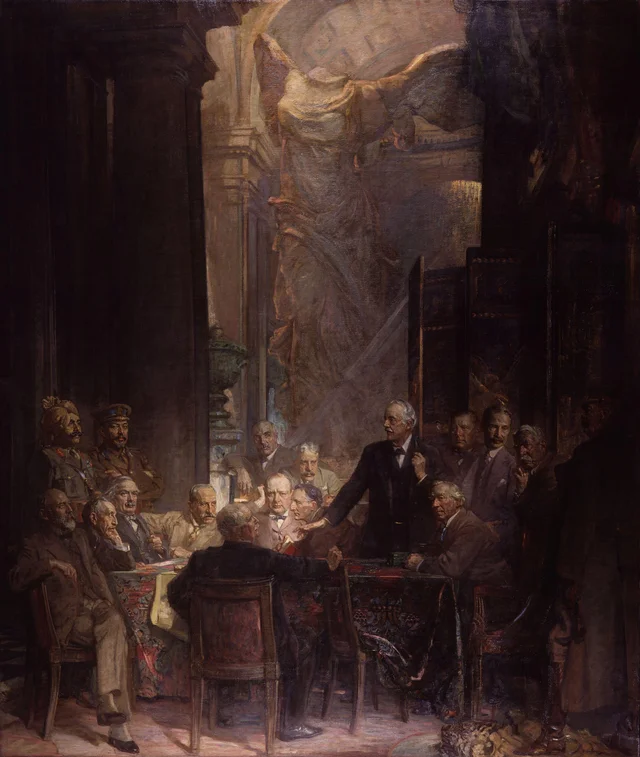
In London's National Portrait Gallery hangs a canvas about four metres tall with 17 men in dark clothes, some seated, some standing, the politicians of Britain and its Dominions who held office during the First World War. Sir Abe Bailey, a South African mining financier, paid for it, and James Guthrie worked on it through the 1920s, making separate studies of every sitter except Lord Kitchener, the war minister who had drowned in 1916. It was finished and given to the gallery in 1930, the year Guthrie died.
That official picture sits at the far end of a career that began in rebellion. Guthrie, born in Greenock in 1859, gave up studying law to paint and had little formal training. In 1881 he painted A Highland Funeral, a dark, almost monochrome scene of mourners gathered indoors, based on a funeral he had witnessed for a drowned boy. It became a rallying point for the Glasgow Boys, a group of young Scottish painters who turned from studio history pieces to rural life painted in the open air, much of it in the village of Cockburnspath, where Guthrie worked in the early 1880s.
Portrait commissions later became his main work. He served as president of the Royal Scottish Academy from 1902 to 1919 and was knighted in 1903.