Jan Weissenbruch
1822–1880 · Kingdom of the Netherlands · Realism, Romanticism
The story
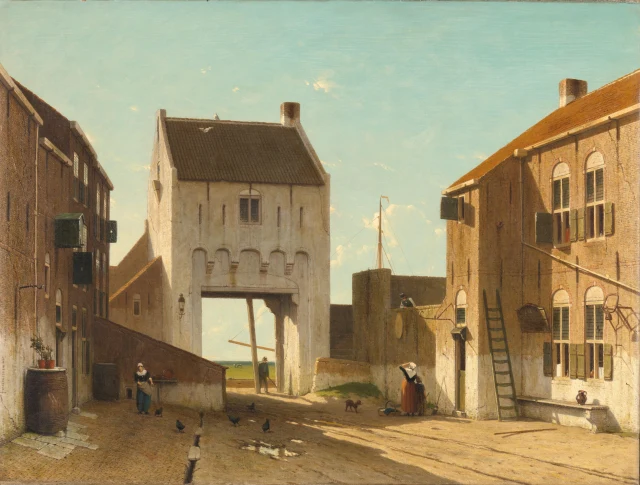
In 1870 the Rijksmuseum bought a sunlit street scene from a living painter in The Hague. It shows the Steigerpoort, one of the town gates of Leerdam, a small town on the river Linge, just after rain. Chickens pick around a puddle, and through the arch you can see the bowsprit of a moored ship. The museum notes that Jan Weissenbruch turned the gate around in his picture, so that its more interesting outer face looks at us.
Weissenbruch was born in The Hague in 1822 and studied at the academy there for eight years. He painted old Dutch towns along the big rivers, Leerdam and Culemborg among them, in minute detail that recalls Jan van der Heyden, the 17th-century painter of Amsterdam street views, and he liked bright sunlight on old brick and canal water. In 1847 he was among the founders of Pulchri Studio, the artists' society in The Hague that still exists. His cousin Jan Hendrik Weissenbruch, two years younger, became one of the best-known landscape painters of the Hague School, and the two names are easily confused.
In his later years Jan suffered from agoraphobia, a fear of open spaces, which put an end to his painting trips. He died in The Hague in February 1880, aged 57.