Jaume Huguet
1492 · Crown of Aragon · Catalan Gothic
The story
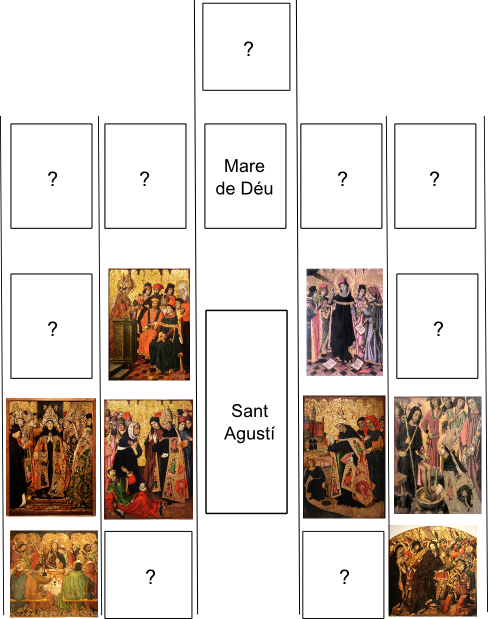
In 1463 Barcelona was at war with its own king. The Catalan civil war against Joan II of Aragon would last ten years, and in that same year the city's tanners' guild signed a contract with Jaume Huguet for a huge altarpiece of Saint Augustine, meant for the high altar of the old Augustinian convent. It was not finished until 1486, and several members of his workshop, among them one of the Vergós family of painters, worked on it.
The panel of the Consecration of Saint Augustine is the one scholars give to Huguet's own hand. Its gold is built up in relief, a hallmark of his workshop, and each face is an individual head. Seven panels of the altarpiece are now in the National Art Museum of Catalonia, and an eighth in the Marès Museum, a sculpture collection in the old city.
Huguet was born in Valls, a town near Tarragona, around 1412, was orphaned as a boy and trained with his uncle Pere, a painter. He moved his workshop to Barcelona in 1448, and for four decades guilds, parishes and the court ordered altarpieces from it. One of them, the Epiphany ordered in 1464 by Peter of Portugal, the prince the Catalan rebels had proclaimed their king, still stands in the royal chapel of Saint Agatha in the old palace.