Jean Germain Drouais
1763–1788 · France · Neoclassicism, History painting
The story
In Rome in 1785, part of Jacques-Louis David's Oath of the Horatii, the arm of one of the three brothers swearing their oath, was painted by his young assistant. That assistant was Jean-Germain Drouais, David's favourite pupil, trusted with a share of the picture that made his master famous.
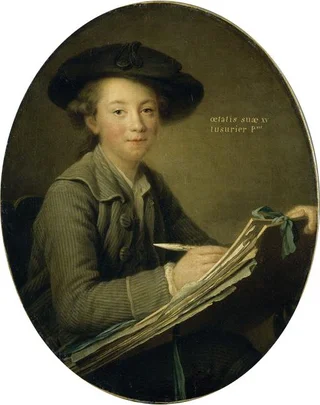
Drouais came from a family of painters. His father and grandfather were fashionable portraitists in Paris, and he joined David's new studio around 1781. His first attempt at the Prix de Rome, the French Academy's top award for young painters, ended badly in 1783. Impatient to hear his teacher's opinion, he cut a piece from his competition canvas and smuggled it out of the closed rooms, which put him out of the running. A year later he won with Christ and the Canaanite Woman, now in the Louvre, and travelled to Rome with David.
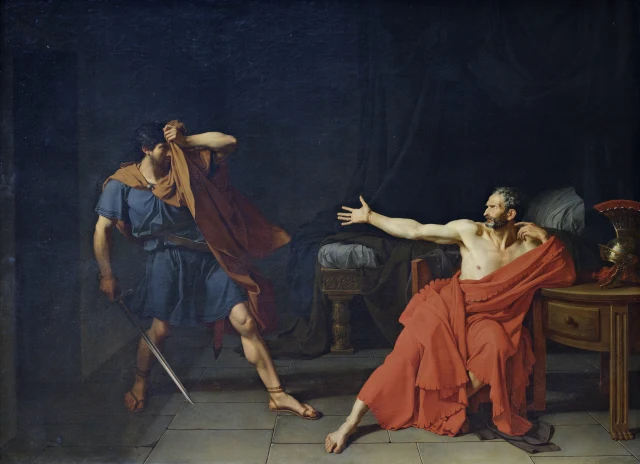
There he painted Marius at Minturnae, finished in 1786. It shows the old Roman general Marius, a condemned prisoner, facing the soldier sent to kill him, who in the ancient story could not bring himself to strike. The poet Goethe, then in Rome, recorded the deep impression it made and judged it in some respects better than David's own work. The canvas, more than three and a half metres wide, was sent to Paris for the Academy's review and now hangs in the Louvre.
Drouais never went home. He died of smallpox in Rome in February 1788, at 24, and his last finished painting was Philoctetes on the Island of Lemnos. His fellow students at the French Academy in Rome raised a monument to him in the church of Santa Maria in Via Lata.