Jean-Louis Hamon
1821–1874 · France · Neo-Grec
The story
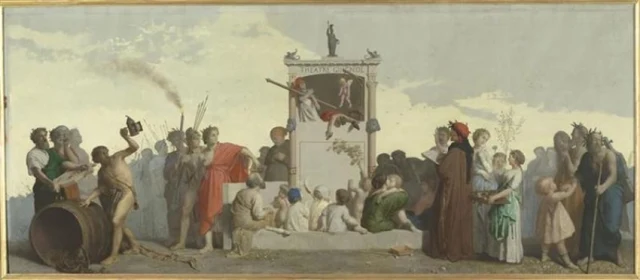
In 1851 Jean-Louis Hamon was working as a designer at the Sèvres porcelain factory, after his first Salon pictures had attracted little notice. An enamelled casket he designed won a medal at the great London exhibition that year, and in 1852 his painting The Human Comedy was shown at the Salon and bought by the state. It puts a Guignol puppet show in the Elysian Fields, watched by figures from antiquity, Socrates among them, and Hamon said the idea came to him while reading Dante.
The picture placed him among the Néo-Grecs, the young painters around Jean-Léon Gérôme who turned ancient subjects into graceful, intimate scenes. Hamon had been born in Plouha in Brittany, was first meant for the priesthood, and studied with Paul Delaroche and Charles Gleyre. Emperor Napoleon III bought his My Sister Is Not at Home. He later spent long periods in Italy, especially on Capri, and died at Saint-Raphaël on the Mediterranean coast in 1874.