Jerónimo Cósida
1510–1592 · Crown of Aragon, Spain · Renaissance, Mannerism
The story
The picture that carries Jerónimo Cósida's name furthest is one nobody can prove he painted. It crowned the high altarpiece of the Cistercian nuns at Tulebras, in Navarre, around 1570. A single monumental figure in a red and gold cloak looks out with three faces that share four eyes, holding up the medieval diagram of the Trinity known as the Scutum Fidei. Scholars attribute it to Cósida. No document ties him to it. Images of that kind did not last long after him, because Pope Urban VIII declared the three-faced Trinity heretical in 1628 and had examples burned, which is why so few survive.
The documented Cósida spent his career in Aragon, between Zaragoza and Tarazona, and by the literature's account never went to Italy. He was artistic adviser to Hernando de Aragón, archbishop of Zaragoza and a grandson of Ferdinand the Catholic, and that position put him inside the cathedral, the Seo, painting alongside the Italian Pietro Morone. Telling the two men's hands apart there is still an open question. His documented commissions run from the high altarpiece of the monastery of Veruela, 1540 to 1544, to the retablo of the Cartuja de Aula Dei outside Zaragoza, which occupied him from 1574 to 1585. He died on 5 April 1592. His birth is another matter: the Prado prints a flat 1510, Wikidata gives about 1510, Spanish scholarship says only before 1510, and no baptism record settles it. Tarazona and Zaragoza both claim the birthplace.
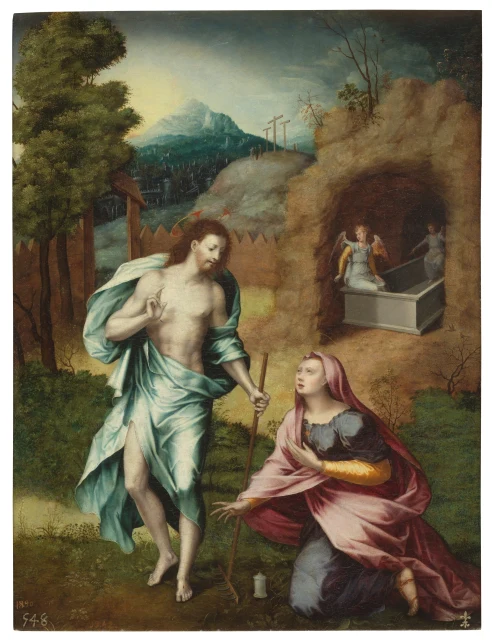
The one panel of his in the Prado, a small Noli me tangere, spent centuries under another name. It appears in Isabella Farnese's 1746 inventory at the palace of La Granja as an old Florentine work, and the attribution to Cósida came much later. The museum dates it no more precisely than about 1570.