Johann Christian Vollerdt
1708–1769 · Electorate of Saxony · Rococo
The story
In the years around 1740 the elector's picture gallery in Dresden was growing fast, as Augustus III, the elector of Saxony, bought paintings from all over Europe, and Johann Christian Vollerdt taught himself landscape by studying it. The gallery held works by two Dutch painters, Herman Saftleven and Jan Griffier, with tiny villages perched above winding river valleys, and that manner stayed with him for the rest of his life.
He had come to painting by a roundabout route. Baptised in Leipzig in 1708, the son of a tapestry maker, he first trained with a Leipzig engraver, Paul Christian Zinck, and moved to Dresden only after 1738 to study with the court landscape painter Johann Alexander Thiele. His first steady work was decorative, overdoors and wall panels for Saxon houses. More than 30 of them were probably made for Oberlichtenau, a country house of Count Heinrich von Brühl, the chief minister of Saxony, and only those in its garden hall survive.
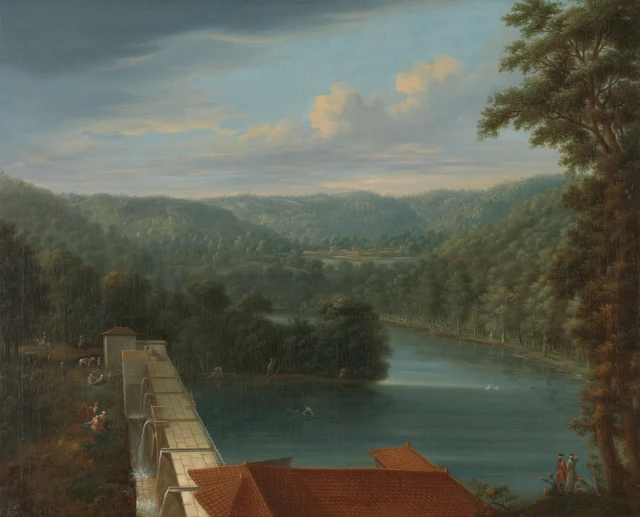
From the late 1750s he painted small, finely detailed river landscapes, often in pairs showing two seasons or two times of day. One unusual commission ended up in Amsterdam. Cornelis Calkoen, the Dutch envoy in Dresden, had him copy a view of the forest outside Istanbul painted by Jean Baptiste Vanmour, and the copy is now in the Rijksmuseum. Vollerdt died in Dresden in 1769, and his landscapes are in Leipzig, Dresden and the Hermitage in St Petersburg.