Johann Friedrich August Tischbein
1750–1812 · Landgraviate of Hesse-Kassel · Neoclassicism, German Romanticism
The story
The Tischbeins were a family of painters from Hesse in central Germany, and so many of them were working at once that people told them apart by city. Johann Friedrich August Tischbein became the Leipzig Tischbein. His uncle Johann Heinrich was the Kassel Tischbein, and his cousin Johann Heinrich Wilhelm is still called the Goethe Tischbein, after his portrait of the poet lounging in the Roman countryside.
Friedrich August was born in Maastricht in 1750, trained in his uncle's studio in Kassel, studied in Paris and spent time in Rome and Naples. In 1780 he became court painter to the Prince of Waldeck at Arolsen, a small German court, and in the 1780s the prince sent him to the Dutch Republic three times. There he found clients at the very top. After the stadtholder William V, head of the House of Orange, returned to The Hague in 1787, Tischbein drew the family in a set of oval pastel portraits that the Rijksmuseum still holds.
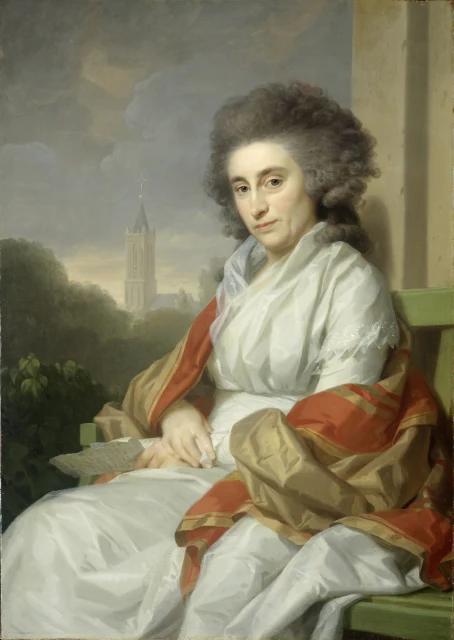
His portraits, the women above all, owe a great deal to the English painters Gainsborough and Romney: soft landscape backgrounds, relaxed poses, a mood of private feeling. In 1800 he took over the Leipzig art academy from Adam Friedrich Oeser, the man who had once taught the young Goethe to draw, and painted the city's merchant families on a grand scale. He died in Heidelberg in 1812, and three of his children, Caroline, Elisabeth and Carl Wilhelm, became painters in turn.