Johann Heinrich Wilhelm Tischbein
1751–1829 · Electorate of Hesse · Neoclassicism, Romanticism
The story
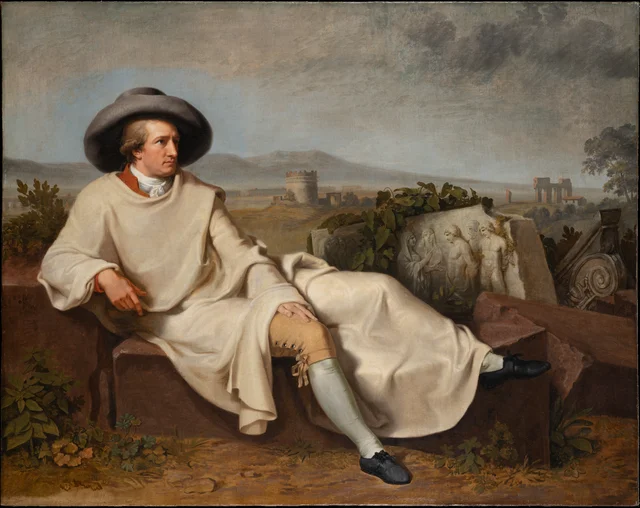
Almost everything most people picture when they imagine Goethe comes from a single canvas by this painter. In 1787 Johann Heinrich Wilhelm Tischbein showed the writer reclining in a traveller's broad hat and pale cloak among broken Roman ruins, gazing across the Campagna, the open country outside Rome. No portrait has done more to fix how we picture Goethe.
The two men were briefly close. Goethe, slipping away from his official duties in Weimar, had come south on the Italian journey that would reshape his writing, and for more than a year the pair shared a flat on the Via del Corso in Rome. Tischbein taught him to draw, and they travelled together to Naples. The friendship lasted only a few months, since their temperaments were too different, and in Naples they went their separate ways.
Tischbein belonged to a large dynasty of German painters, so numerous that historians number them to tell them apart. He spent his later decades as court painter in Oldenburg, in northern Germany, turning out mythologies and portraits. He never quite finished the great Goethe canvas to his own satisfaction, yet it hangs today in the Städel Museum in Frankfurt as the definitive image of the poet.