Johann Paul Schor
1615–1674 · Austrian · Baroque
The story
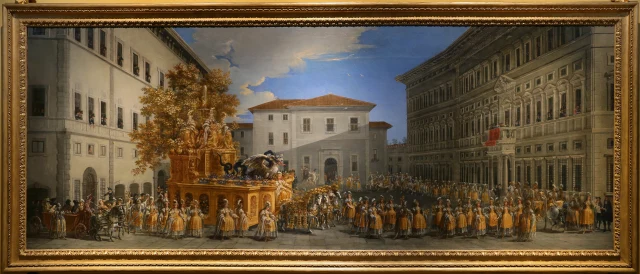
In the Rome of the 1650s and 1660s, the grand spectacles that impressed visiting kings and cardinals — the gilded state beds, the ceremonial coaches, the fireworks, even banquet centrepieces sculpted in sugar — often began as drawings by a Tyrolean named Johann Paul Schor. Romans called him Giovanni Paolo Tedesco, Paul the German. He had come from Innsbruck around 1640, trained in his father's busy workshop, and joined the Accademia di San Luca, the city's painters' academy, in 1654.
Schor worked in the orbit of Gian Lorenzo Bernini, the sculptor and architect who dominated Baroque Rome, and the two staged festivals together for the aristocracy and the higher clergy. So many of his designs passed through that circle that later collectors filed his drawings under Bernini's name for centuries. Bernini himself recommended him to Louis XIV of France as an artist who could turn his hand to anything.
His reputation rests less on surviving easel paintings than on that vanished world of one-night spectacles, ceremonial coaches and stage machinery. One of his rare paintings on canvas now hangs in the Uffizi, which acquired it as a leading example of 17th-century decorative art.