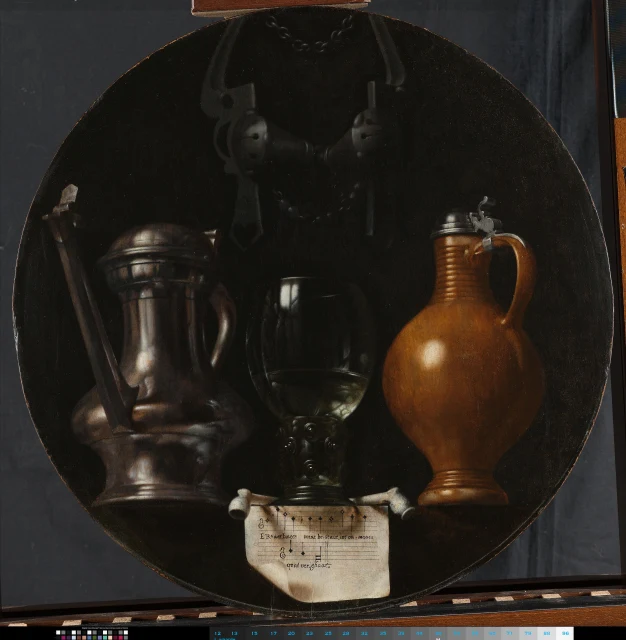
Johannes Torrentius
1589–1644 · Dutch Republic · Dutch Golden Age, Baroque
The story
Around 1913, in Enschede, a town in the east of the Netherlands, a round wooden panel turned up serving as the lid of a barrel of raisins. Cleaned at the Rijksmuseum, it revealed a monogram and the date 1614. It was a still life by Johannes Torrentius, and it is the only painting of his known to survive.
On a shelf stand a pewter wine flagon, a glass and an earthenware water jug, with a bridle hanging above and a sheet of music bearing a verse about measure. The museum reads it as an allegory of moderation, urging the viewer to temper wine with water. Its painter had a very different reputation. Born in Amsterdam as Johannes Symonsz van der Beeck, he grew rich and famous in Haarlem, and Constantijn Huygens, secretary to the stadholder, rated him the finest still-life painter of his time. He kept his technique a secret.
In 1627 he was arrested in Haarlem on suspicion of belonging to the Rosicrucians, a secretive brotherhood that alarmed the Dutch authorities. He was tortured, and the Haarlem chronicler Samuel Ampzing described him clamped in irons and hung with weights. In January 1628 he was sentenced to 20 years for godlessness, blasphemy and scandalous living, and most of his paintings are thought to have been destroyed. Charles I of England, who admired his work, asked the stadholder Frederik Hendrik to free him, and in 1630 Torrentius left for England. The branded owner's mark of Charles I is still on the back of this panel. He returned to Amsterdam in 1642 and died there in 1644.