John Frederick Kensett
1816–1872 · United States · Hudson River school
The story
In the autumn of 1872 John Frederick Kensett waded into Long Island Sound to recover the body of a friend's wife who had drowned there, caught a chill, and died that December at 56. In his studio his executors found a group of about 38 canvases from his final months, quickly christened the Last Summer's Work.
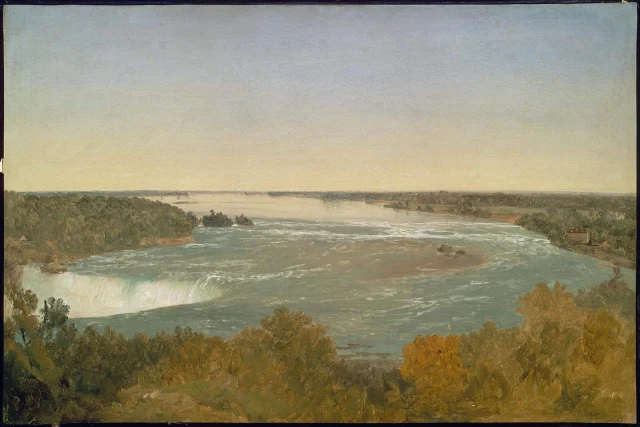
Kensett was by then the acknowledged leader of the second generation of the Hudson River School, the American landscape painters who treated their country's shorelines and mountains as worth the reverence Europeans gave cathedrals. He is remembered above all for luminism, a way of painting still water and pale, level light so quietly that all the drama drains out of the scene. A late seascape like Eaton's Neck is almost bare, just a curve of beach, a broad calm sky, and very little else.
He had trained as a bank-note and map engraver before he turned to oils, and that draftsman's precision never left him. The Last Summer's Work sold at auction the year after he died, and several of the paintings entered the Metropolitan Museum of Art, which he had helped found in 1870.