John Glover
1767–1849 · Kingdom of Great Britain, Van Diemen's Land · Romanticism
The story
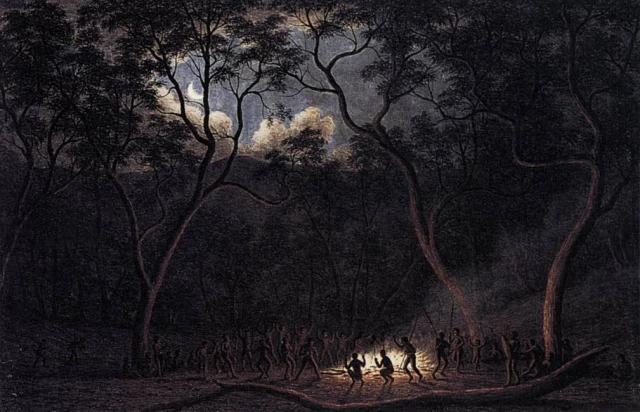
On the back of a canvas now in the Louvre, an old man wrote in October 1840 that he had seen more enjoyment and mirth at an Aboriginal dance than he ever saw in a ballroom in England. The painter was John Glover, then 73, and the picture shows a corroboree, a night ceremony of song and dance, in the bush of Van Diemen's Land, the British colony now called Tasmania.
Born in Leicestershire in 1767, Glover had been a founding member of the Society of Painters in Water-Colours in London, known as the English Claude, after the French painter Claude Lorrain, for his golden Italianate landscapes. In 1831, aged 64, he followed three of his sons to Hobart and took a land grant below the mountain Ben Lomond, where he built a farm he called Patterdale.
He arrived as the Black War between settlers and Aboriginal Tasmanians was ending. Killings and disease had left only a few hundred Aboriginal people alive, and many historians now call what happened genocide. In January 1832 Glover sketched a group of Big River and Oyster Bay people whom the government's conciliator, George Augustus Robinson, had brought into Hobart. Ten days later they were shipped into exile on Flinders Island in Bass Strait. His later corroborees, with dancers in a landscape free of settlers, were built from those sketches and from memory, when almost no Aboriginal people were left on the land he painted.
Glover sent this picture with five others to the French king Louis-Philippe at the Château d'Eu. In 1845 the king chose two of them, recorded as curiosities and paid for from a fund for royal gifts.