John Steuart Curry
1897–1946 · United States · Regionalism
The story
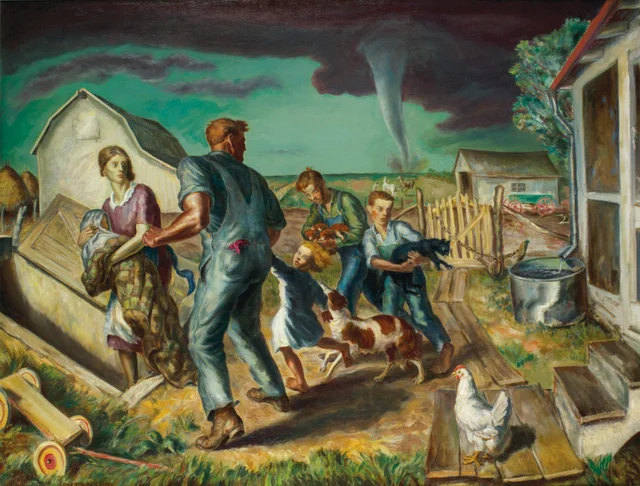
In 1929 John Steuart Curry spent six weeks on his family's farm near Dunavant, Kansas, then went back to his studio in Westport, Connecticut, and painted the kind of storm he had grown up with. Tornado Over Kansas shows a farm family hurrying toward their storm cellar as a black funnel crosses the fields behind them. It won a second prize at the Whitney Studio Club in New York in 1930, and in 1935 the Hackley Art Gallery in Muskegon, Michigan, bought it. It hangs there still.
Pictures like this made Curry famous in New York, alongside Grant Wood of Iowa and Thomas Hart Benton of Missouri, the painters grouped together as the Regionalists. His Baptism in Kansas, a country baptism in a farm water tank, had made his name in 1928 and is now in the Whitney Museum of American Art. Kansans were less pleased. Some felt he showed their state through cyclones and floods, and the wife of a Kansas governor complained about his freakish subjects.
That tension followed him home. In 1936 the University of Wisconsin made him the first artist-in-residence at its College of Agriculture, and from 1937 he painted murals for the Kansas State Capitol in Topeka. The central scene, Tragic Prelude, shows the abolitionist John Brown with a tornado and a prairie fire behind him. When the legislature refused to remove marble panels to make room for the rest of the cycle, Curry left the murals unsigned. He died in Madison, Wisconsin, in 1946, at the age of 48.