Josef Ignaz Mildorfer
1719–1775 · Holy Roman Empire · Baroque
The story
In 1759 Josef Ignaz Mildorfer, a professor of painting, was barred from entering the Vienna Academy of Fine Arts. The reasons were never recorded, and he was not the only artist shut out. It was a strange turn for a man who had made his name there. In 1741 he had won the academy's drawing competition, and a year later its painting prize, as a pupil of Paul Troger, the Tyrolean fresco painter who later ran the academy.
Around 1750 the academy was a place of experiment, where painters from the Tyrol such as Troger and Mildorfer, born in Innsbruck in 1719, pushed movement, expression and light to extremes. The Belvedere called its 2019 exhibition on him Rebel of the Baroque. He also worked for the court, painting frescoes for Maria Theresa in the menagerie pavilion at Schönbrunn and the dome of her family's vault in the Capuchin crypt, both still in place.
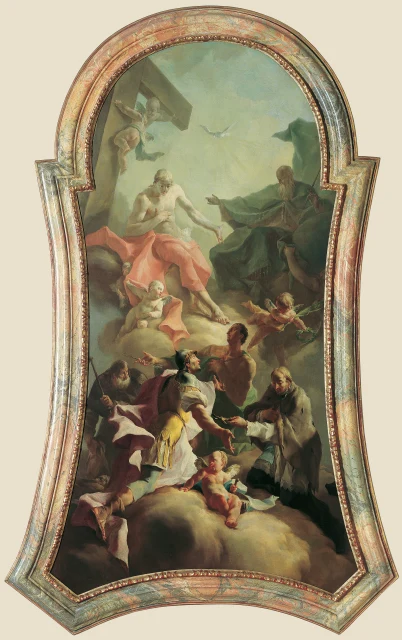
The Belvedere's altarpiece of about 1755 once stood above the high altar of the chapel of Thurnmühle Castle in Schwechat, near Vienna, and the brewer Anton Dreher gave it to the museum in 1914. Four saints crowd a low cloud beneath the Holy Trinity. Behind are Roch and Sebastian, invoked against plague, Roch pointing to his sore with the dog that brought him bread. In front kneel John of Nepomuk and Florian, both drowned in rivers and both called on against the dangers of water. After losing his post Mildorfer kept working for abbeys and nobles, including Prince Nikolaus Esterházy, Haydn's employer, whose palace chapel at Fertőd has his dome fresco. He died in Vienna in 1775.