Josef Rebell
1787–1828 · Holy Roman Empire, Austrian Empire · Romanticism
The story
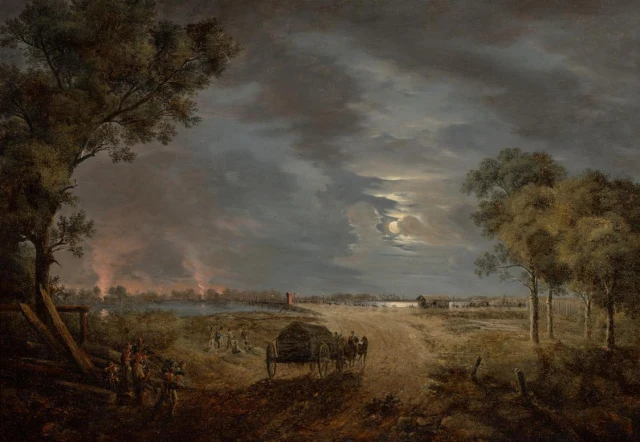
In 1809 French troops occupied Vienna, and Napoleon's army bridged the Danube onto the Lobau, a large island just downstream of the city, before the battles of Aspern and Wagram. The invasion sent a young Viennese landscape painter, Josef Rebell, to Switzerland and then to Milan. There he found a patron in Eugène de Beauharnais, Napoleon's stepson and viceroy of Italy, and in 1810 painted for him four views of the Lobau. One of them, now in the Belvedere, shows the French army's temporary bridge to the island by moonlight.
Rebell, the son of a poor Viennese tailor, was born in 1787 and trained at the Vienna Academy under the landscape painter Michael Wutky. From 1813 he worked in Naples and Rome, painting the Gulf of Naples, the Amalfi coast and the islands, and the southern light of those pictures made his name with collectors across Europe.
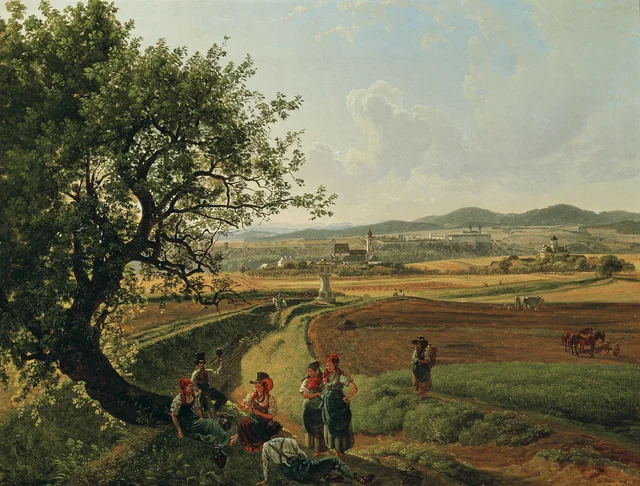
In 1819 Emperor Franz I of Austria saw his landscapes at an exhibition in Rome and ordered four large views of the Naples region, which are also in the Belvedere today. In 1824 the emperor made him director of the imperial picture gallery in the Upper Belvedere, without Rebell having applied for the post, and he also became professor of landscape painting at the Academy. From his later years comes a view of the imperial estate at Emmersdorf on the Danube, with Melk Abbey in the distance, dated 1826.
In the autumn of 1828 he travelled to Dresden to rest, fell ill there and died after eight weeks in bed, a few weeks short of his 42nd birthday.