Joseph Kutter
1894–1941 · Luxembourg · Expressionism
The story
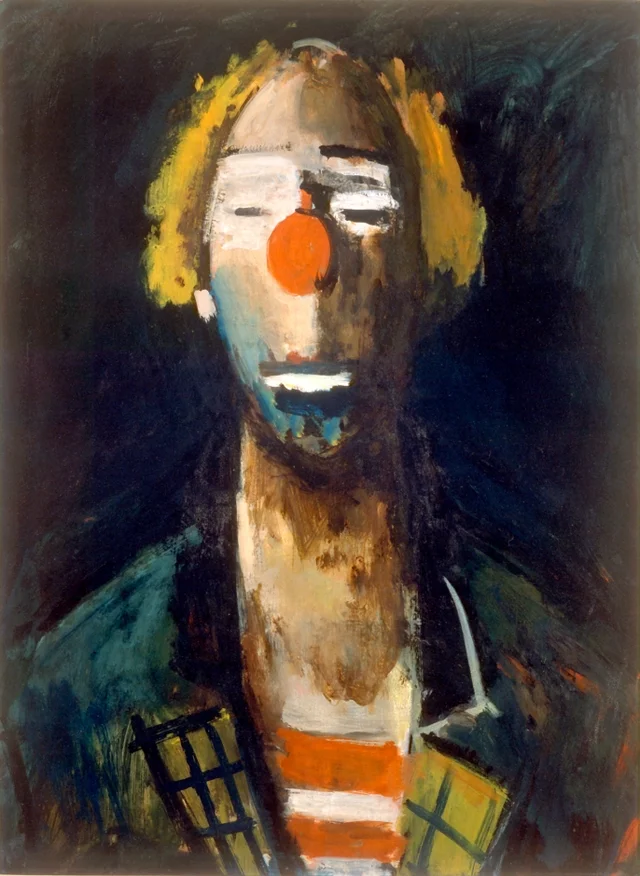
The clowns entered Joseph Kutter's painting in 1935, after a variety show in Luxembourg. Soon they looked different. From 1936 the painter suffered from a painful illness that his doctors could not diagnose, and between attacks he painted clowns with heavy, oversized features and anxious, suffering faces, in thick strokes of intense colour. Head of a Clown, from about 1937, belongs to that late series and is in the National Museum of Archaeology, History and Art in Luxembourg City.
Kutter was the son of Paul Kutter, an early Luxembourg photographer. He studied decorative art in Strasbourg and Munich, spent 1917 and 1918 at the Munich Academy, and turned to Expressionism around 1918, showing with the Munich Secession before he returned home in 1924. In 1926 he exhibited at the Salon d'Automne in Paris and helped found the Luxembourg Secession, the country's avant-garde group. After 1933 he stopped exhibiting in Germany, where the Nazi regime classed his art as degenerate. His last large commission, two big views of Luxembourg and Clervaux for the Paris International Exposition of 1937, was painted while he was already ill. He died in Luxembourg City in January 1941, aged 46.