Joseph Paelinck
1781–1839 · Belgium, Austrian Netherlands, France, United Kingdom of the Netherlands · Neoclassicism, Romanticism
The story
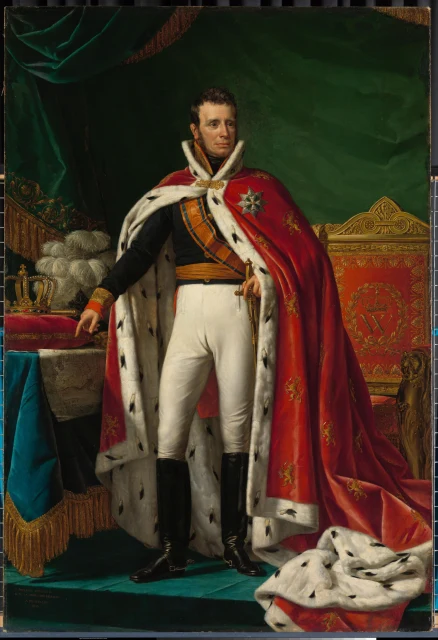
In 1819, in Brussels, Joseph Paelinck painted William I, king of the new United Kingdom of the Netherlands, standing full-length in a general's uniform and an ermine-lined robe. The king points to a map of Java, and that detail tells you where the picture was headed. It was sent to the Dutch colony, and from 1821 it hung in the governor's palace there. Today it is in the Rijksmuseum in Amsterdam.
Paelinck was born in 1781 in Oostakker, near Ghent, when the region still belonged to the Austrian Netherlands. After the Ghent academy he went to Paris to train under Jacques-Louis David, the leading painter of Napoleonic France, and in 1804 his Judgment of Paris won the Ghent academy's first prize. A Ghent scholarship then took him to Rome from 1808 to 1812, where he worked on the decoration of the Quirinal Palace, then being refitted for Napoleon.
When the northern and southern Netherlands were joined under William in 1815, commissions followed. Paelinck became a court painter, moved to Brussels and painted the queen as well as the king. His Toilet of Psyche of 1823, showing the mythical princess naked at her dressing table among her attendants, is also in the Rijksmuseum. As Romanticism took hold his work fell out of favour, and his late attempts in the new style were poorly received. He taught at the Brussels academy, where the young Alfred Stevens, later a celebrated painter of Parisian women, was among his pupils, and he died in Ixelles, just outside Brussels, in 1839.