Josephus Augustus Knip
1777–1847 · Kingdom of the Netherlands · Neoclassicism
The story
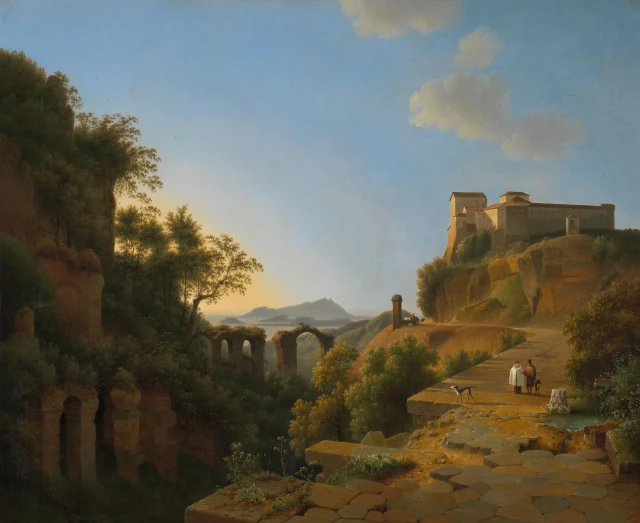
The Gulf of Naples, painted in 1818, shows a view that never existed. Josephus Augustus Knip placed the bay, with the island of Ischia and its volcano Epomeo, behind Roman ruins that actually stand in Rome itself, among them the Colosseum, an aqueduct of Nero and the church of Santi Quattro Coronati. He assembled it in the Netherlands from studies made years before, and the Rijksmuseum bought it the same year.
Those studies came from a rare chance. Louis Napoleon, Napoleon's brother and King of Holland, awarded Knip the first Dutch Prix de Rome, and from November 1809 to September 1812 he drew and painted watercolours in and around Rome, and travelled to Naples and into the hills beyond. He kept these sheets as working material, never meant for sale, and went on building larger landscapes from them after he came home.
Knip had been trained by his father, a decorative painter, and spent nine years in Paris making topographical views before Italy. In 1808 he married the French bird painter Pauline de Courcelles. In the late 1820s he began to lose his sight, and by 1832 he was completely blind. He was the first teacher of his daughter Henriëtte Ronner-Knip, who became a well-known painter of cats and dogs. He died in Berlicum, near 's-Hertogenbosch, in 1847.