Józef Chełmoński
1849–1914 · Congress Poland · Realism
The story
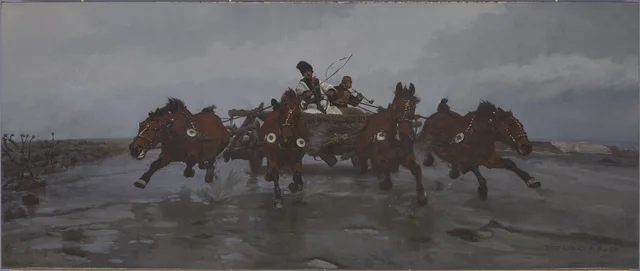
Chełmoński's most famous pictures come at you at a gallop. A team of four horses charges straight out of the canvas, hooves throwing up mud, the driver leaning back on the reins, the flat Polish plain stretching behind. He painted the best known of these, "Four-in-Hand", in 1881 in Paris, where such wild scenes of the east found eager buyers.
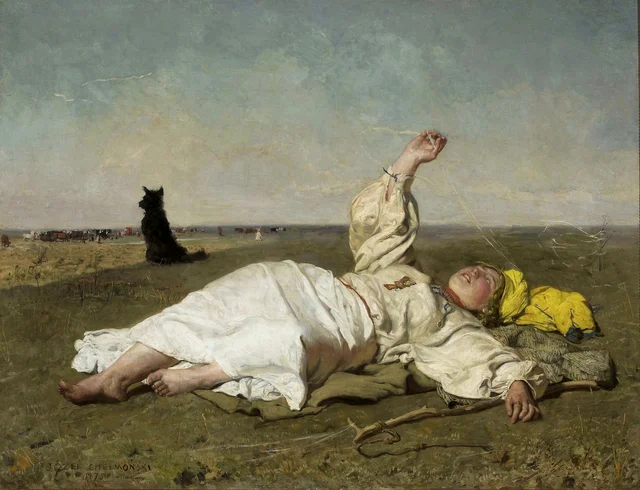
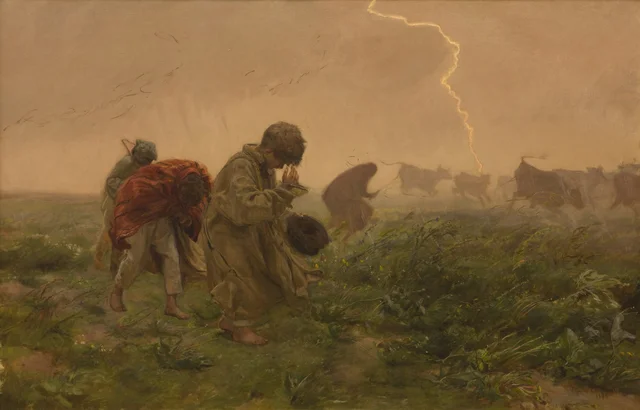
He had trained in Warsaw under Wojciech Gerson, a respected teacher, then spent the early 1870s in Munich, a magnet for painters from across central Europe. Poland at the time did not exist as a state, its lands divided between Russia, Prussia and Austria, and Chełmoński's scenes of peasant life and open steppe carried a quiet charge of national feeling for people who had no country on the map.
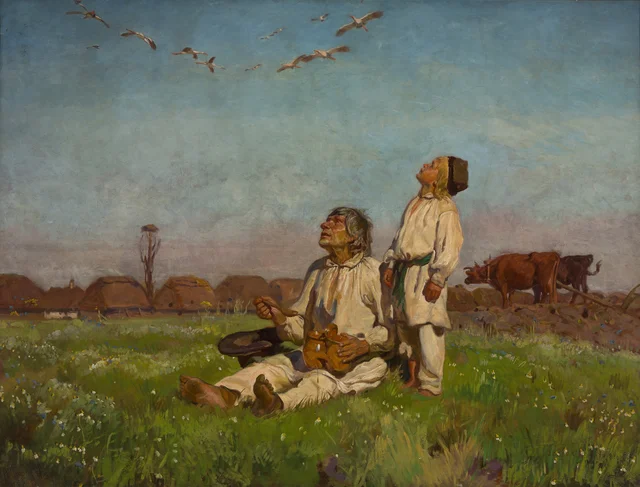
In 1887 he left the success of Paris behind and went home for good, settling two years later in the village of Kuklówka in Mazovia, the region around Warsaw. There he painted partridges over the snow, cranes above the marshes and the slow turning of the rural seasons until his death in 1914.