Józef Pitschmann
1758–1834 · Habsburg Monarchy, Polish–Lithuanian Commonwealth, Russian Empire · Neoclassicism
The story
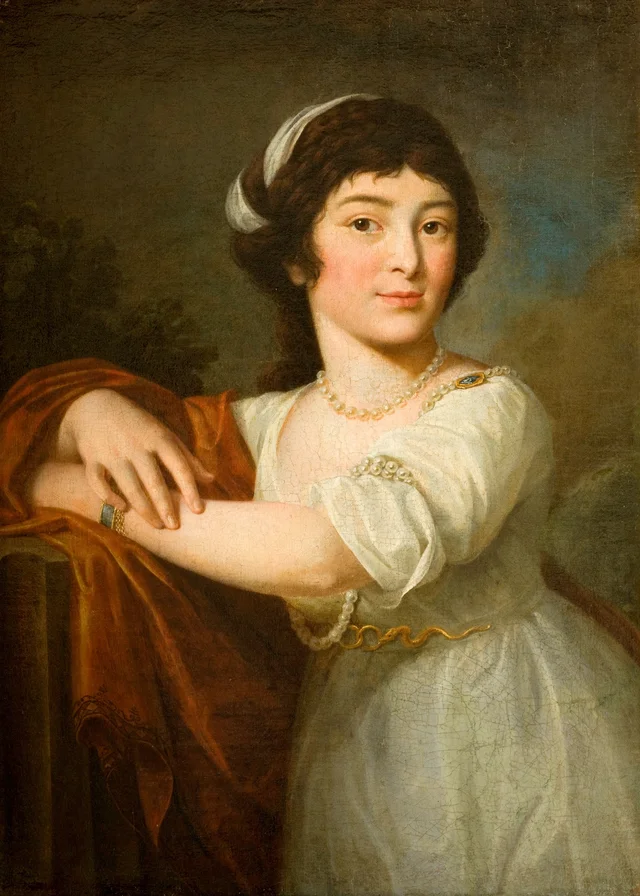
Between 1794 and 1806 he lived in Lwów and produced more than 300 portraits there, among them the Emperor Francis I and his wife. The portrait of Joanna Dzierzbicka, painted in 1800, belongs to those years.
Józef Pitschmann was born in Trieste in 1758 and trained at the Vienna Academy under Heinrich Friedrich Füger and Johann Baptist Lampi, the portraitists who set the neoclassical formula for court likenesses across central Europe. The Academy gave him a gold medal in 1787 and made him a member. A year later Prince Józef Klemens Czartoryski invited him to Poland, where he spent a year at Korzec in Volhynia as house portraitist and drawing master before moving on to Warsaw, painting the nobility and the king, Stanisław August.
The partitions drew the rest of his map for him. Warsaw fell to Prussia in 1795, Lwów was Austrian, Volhynia was Russian, and in 1806 Pitschmann settled at Krzemieniec, where the educational reformer Tadeusz Czacki had founded a lyceum and hired him to teach drawing. He made some 150 paintings in those last decades, mostly professors of the school and the gentry of the province, and he died in the town in 1834.