Juan de Arellano
1614–1676 · Spain · Baroque
The story
The first job anyone can attach Juan de Arellano's name to is not a picture. In 1636, in his early twenties, he was paid to decorate a carriage. He had trained with the Madrid painter Juan de Solís and spent years on modest decorative work of that kind. According to Antonio Palomino, the painter and biographer who wrote about him some 50 years after his death, Arellano reached the age of 36 without having shown much aptitude for anything, then took up flowers on the calculation that flower pieces paid better than figures and cost less labour.
The calculation held. From about 1650 he kept a shop and workshop on the Calle Mayor, opposite the steps of the convent of San Felipe el Real, where Madrid gathered to trade news, and sold flower paintings out of it with the help of assistants. His sons worked for him, and so did his son-in-law Bartolomé Pérez, who by Palomino's account painted the small figures in his garlands. That division of labour is the usual explanation for how unevenly made the pictures signed with his name are.
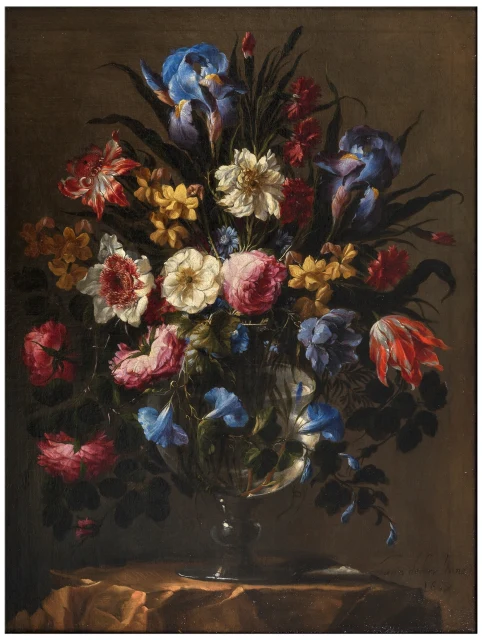
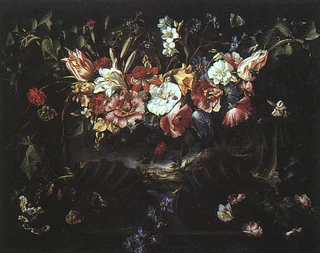
His bouquets look observed from life, and he is said to have built them in the studio from real flowers. Botanists who have gone through the canvases find something odd. A single one of them will hold flowers that bloom in different months and could not have stood in one vase together, which suggests he worked from a stock of drawn studies and picked what he wanted from it.