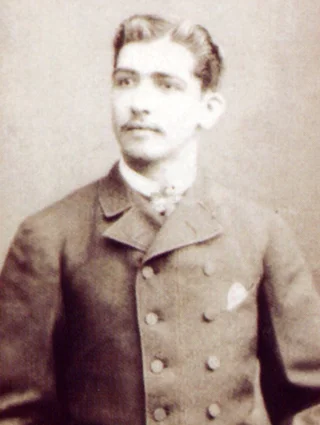
Juan Lepiani
1864–1932 · Peru · Academic art, Realism, Historicism
The story
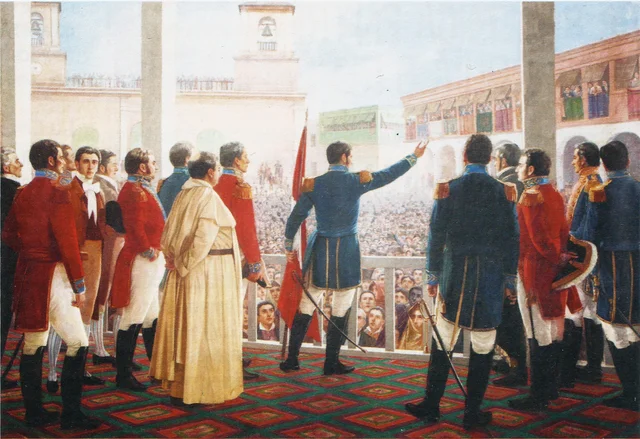
Peruvian schoolbooks show the moment of independence through one picture. General José de San Martín, the Argentine-born liberator, stands on a balcony above a crowd in Lima and holds up the new flag, with officials and clergy pressed in behind him. Juan Lepiani painted it in Rome in 1904, almost four metres wide, and took liberties along the way. The real proclamation of 1821 was read from a platform in the main square, and the flag he shows is a design adopted only in 1822. Most of the figures turn their backs to us, since few likenesses survived. The art historian Luis Eduardo Wuffarden has pointed out that the one face on the balcony looking out at the viewer is Lepiani's own.
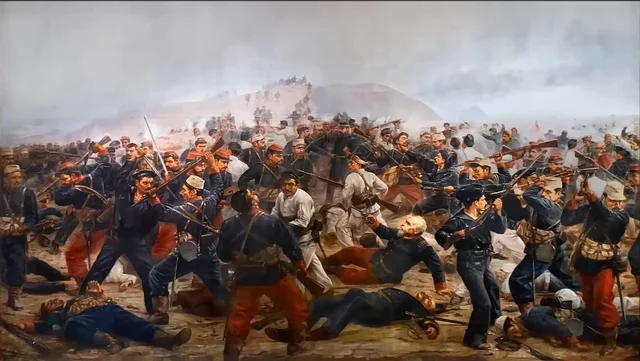
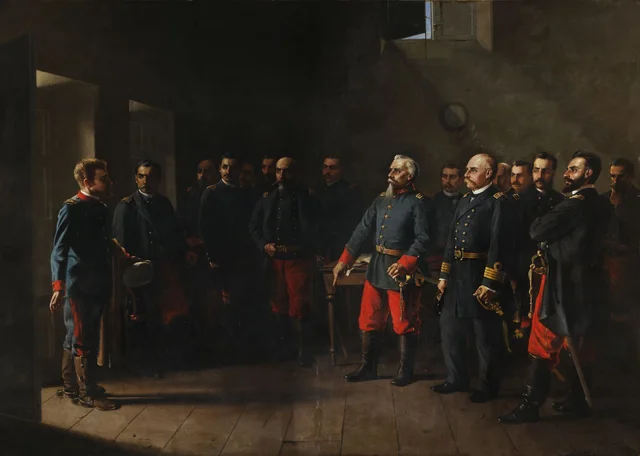
Lepiani came to painting after jobs that included paymaster on Peru's Central Railway, and learned from two teachers in Lima, one of them Ramón Muñiz, a Spanish painter living there. From the 1890s he took up the War of the Pacific, the war of 1879 to 1884 in which Chile defeated Peru and Bolivia. His Respuesta, now in the Casa Bolognesi museum in Lima, shows Colonel Francisco Bolognesi, commander of the port of Arica, telling a Chilean envoy that he would fight until his last cartridge was spent. In The Last Cartridge of 1899 he painted Bolognesi's death in the battle that followed, on 7 June 1880.
In 1903 Lepiani went to Europe and stayed in Rome, where he painted little of his own and lived mostly by copying Raphael and Titian for American tourists. Years of copying in poor light ruined his eyesight. He died in Rome in 1932, blind and penniless.