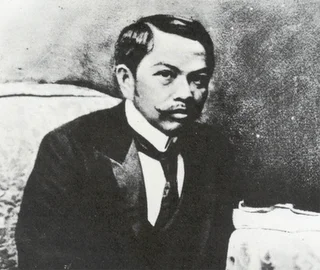
Juan Luna
1857–1899 · Philippines · Academic art
The story
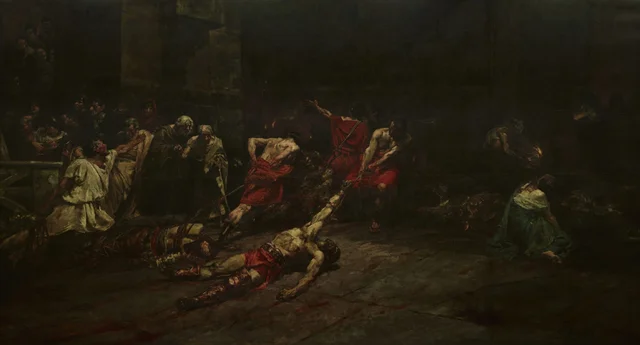
In 1884, at the national fine-arts exhibition in Madrid, the top gold medal went to a painter from the Spanish colony of the Philippines. The canvas was the Spoliarium, a vast dark scene of dead gladiators being dragged from a Roman arena, and Filipino reformers living in Spain read it at once as a picture of their own people under colonial rule. At a banquet in Luna's honour the writer José Rizal, later the martyred hero of Philippine independence, toasted the prize as proof that a Filipino could stand beside any European.
Luna had learned to paint partly on a merchant ship and partly in Rome, and worked in the grand history-painting manner the Salons still rewarded. Success carried him to Paris, where he turned out society interiors and married Paz Pardo de Tavera, from a wealthy Filipino family.
The marriage ended in blood. Convinced his wife was unfaithful, Luna shot her and her mother in their Paris flat in 1892, and a French court, accepting a plea of a crime of passion, acquitted him the following year. He went back to the Philippines, joined the revolution against Spain as it broke out, and served the short-lived first republic on a diplomatic mission abroad. He died of a heart attack in Hong Kong in 1899, at 42, the Spoliarium already fixed as the founding monument of Filipino painting.