Jules-César-Denis van Loo
1743–1821 · France · Rococo, Neoclassicism
The story
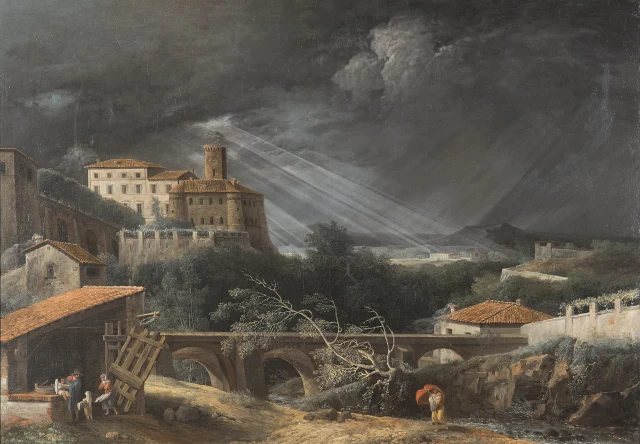
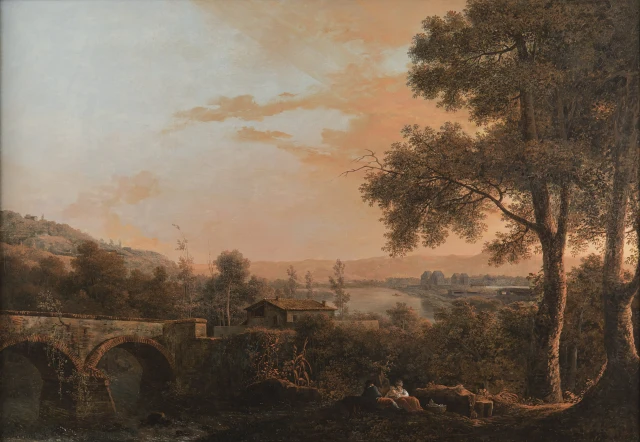
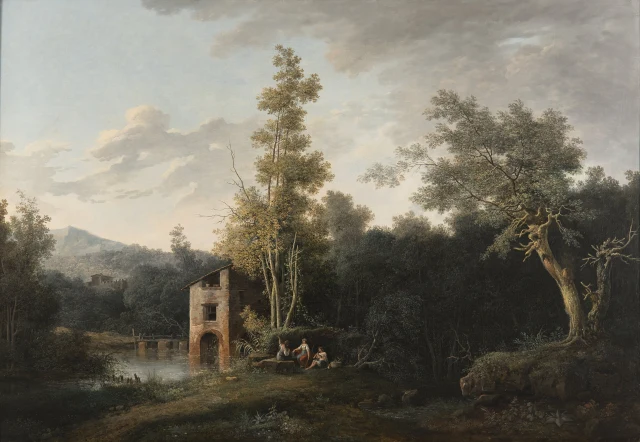
Jules-César-Denis van Loo was a son of Carle van Loo, First Painter to Louis XV, and of Cristina Somis, a singer from Piedmont. He signed his pictures simply César van Loo, and he was the last painter of a family that had produced them for four generations.
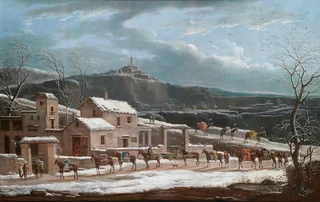
He made his name with landscapes, and the Royal Academy in Paris admitted him as a member in 1784. Around 1790 or 1791, in the first years of the Revolution, he settled in Turin and worked for the court of the kings of Sardinia, as his father and his uncle Jean-Baptiste had done before him. In Piedmont he took up the winter scenes of the Italian painter Francesco Foschi, and by the end of the decade snow had become his speciality.
In 1799 he sent to the Paris Salon a snowbound ruin of a Gothic church with a bridge in the distance. It won a prize and was bought by the French state, and it now belongs to the château of Fontainebleau. He died in Paris in 1821.