Julio González
1876–1942 · Spain · Abstract art
The story
Julio González grew up in a Barcelona family of metalworkers, learning to cut, hammer and solder iron in his father's workshop before he thought of himself as an artist. He moved to Paris in 1900, painted for years without much success, and only in his fifties turned that early trade into something new.
Around 1928 his old Barcelona friend Pablo Picasso asked for help making sculpture out of welded metal. For a few years the two worked closely, and González showed the painter how to handle a torch. Out of it came a genuinely new thing in modern art: sculpture drawn in open space with thin rods and sheets of iron, open and see-through where sculpture had always been a solid carved or cast mass. His standing women, some of them combing their hair, are almost line drawings hanging in the air.
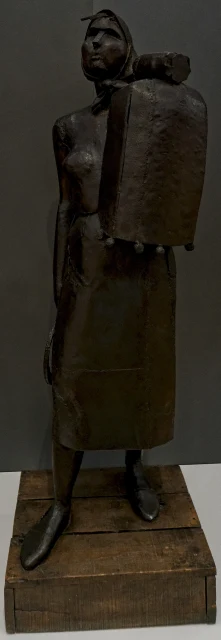
In 1937 González made La Montserrat, a peasant woman clutching a child and a sickle, her face turned upward. It stood in the pavilion of the Spanish Republic at the Paris World's Fair, in the same rooms as Picasso's Guernica, both of them answering the war then tearing Spain apart. He died near Paris in 1942, under the German occupation, when metal was scarce and he could barely work.