Kanō Eitoku
1543–1590 · Japan · Kanō school
The story
In the 1570s the warlord Oda Nobunaga was building Azuchi Castle on the shore of Lake Biwa, a tower meant to announce that Japan had a new master. To decorate it he hired Kanō Eitoku, then in his thirties and already head of the Kanō school, the workshop that would serve Japan's rulers for centuries.
Eitoku painted for the men unifying the country by force. After Nobunaga came Toyotomi Hideyoshi, and for both he covered sliding doors, walls, and ceilings with bold designs on backgrounds of gold leaf, a style suited to dim castle interiors where gold caught what little light there was. He worked large and fast, with broad brushwork and monumental trees and birds.
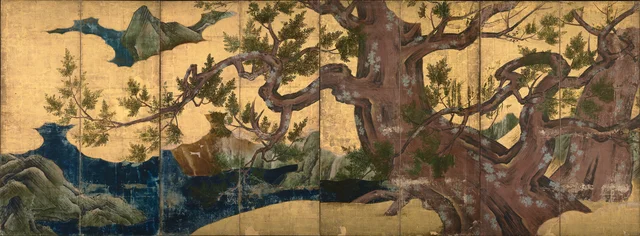
Almost none of it survives. Azuchi Castle was burned within a few years of its completion, and Hideyoshi's palaces are gone too, so the wall paintings that made Eitoku famous are known mostly from records. One late work does remain: a pair of folding screens of a great cypress on gold, now in the Tokyo National Museum and designated a National Treasure, thought to have begun as sliding doors in a Kyoto residence finished in 1590, the year he died.