Katsushika Ōi
Japan · Ukiyo-e
The story
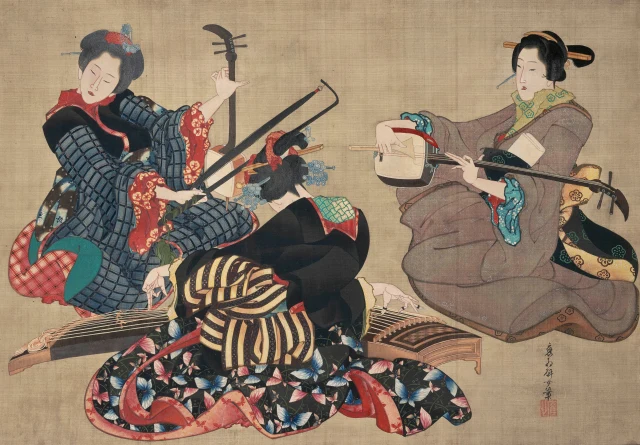
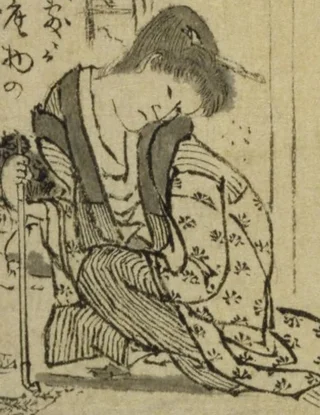
In the crowded print shops of Edo, now Tokyo, one of the finest brushes of the age worked mostly under someone else's name. Katsushika Ōi was the daughter of Hokusai, the man behind the Great Wave, and for the last two decades of his long life she ran his studio, ground his colours, and painted passages he signed as his own. He said so himself, admitting she could handle certain things better than he could.
She had come back to that studio after a short marriage ended. Her husband was a minor artist, and by the family's account she could not stop criticising his drawing, so she returned to her father and took up the brush for good. What survives under her own name is small, perhaps ten paintings, but it is startling. Ōi was fascinated by light in darkness in a way almost no ukiyo-e artist attempted.
Her best-known work shows the Yoshiwara, Edo's licensed pleasure district, at night: courtesans behind a wooden lattice, lit by lanterns whose glow she tracks across faces and cloth while the street around them falls into deep shadow. The effect stands closer to European candlelight painting than to the flat colour of a woodblock print. Her death is undated. The records lose her in the 1850s, a few years after her father died.